
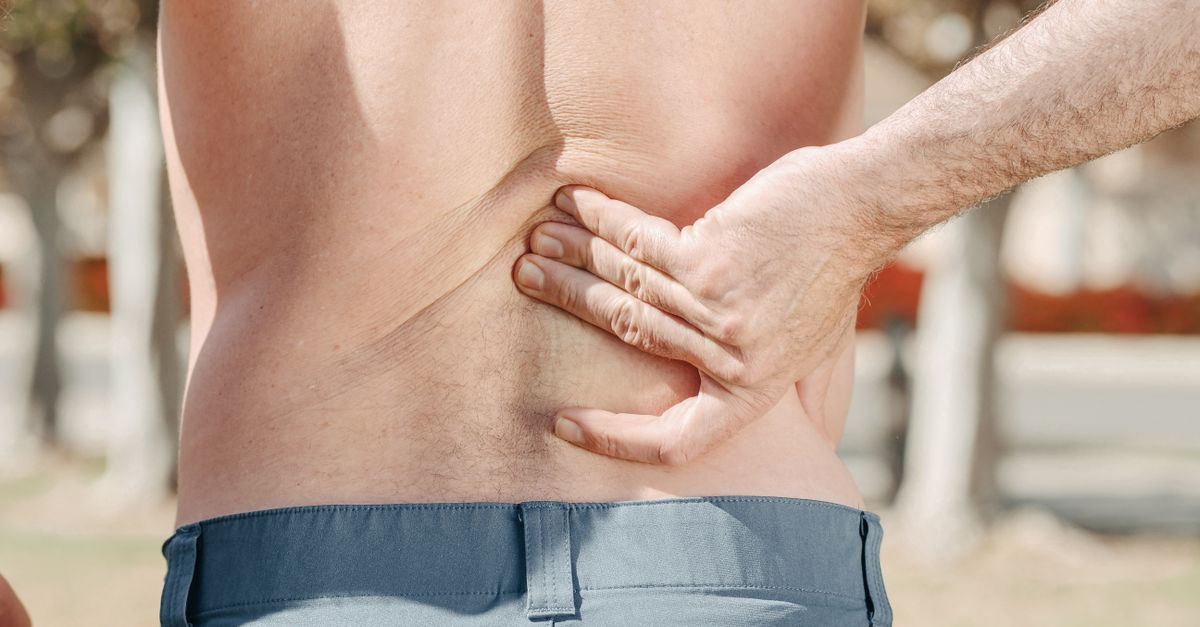
Quadratus lumborum pain is a deep, usually one-sided ache in the lower back, felt between the bottom rib and the top of the hip bone. It comes from the quadratus lumborum (QL), a muscle that connects the pelvis to the lowest rib and the lumbar spine. Prolonged sitting, lifting with a twist, and standing with your weight shifted onto one leg are frequent triggers. Gentle stretching, self-massage, posture changes, and regular movement breaks typically ease muscular QL pain, while numbness, leg weakness, fever, or bladder changes call for prompt medical care.
You stand up after an hour at your desk, and a deep ache grabs one side of your lower back, just above the hip. That one-sided catch is a textbook sign of quadratus lumborum pain, which comes from a muscle that gets little attention until it locks up.
Rolling over in bed hurts. Getting out of the car hurts. A sneeze can make you wince.
The QL sits deep beneath the larger back muscles, so it is easy to misread the pain as a spine problem, a hip problem, or even a kidney issue. Knowing where this muscle is and what it does makes the ache far less mysterious. It also tells you which stretches and self-massage techniques are worth your time.
This guide is written for desk workers, people who lift or carry loads on one side, and anyone with a stubborn ache on one side of the lower back. It covers QL anatomy, symptoms, causes, stretches, a self-massage routine, and the red flags that mean you should see a doctor.
Where Is the Quadratus Lumborum Muscle?
The quadratus lumborum is one of the deepest muscles of the lower back. The Cleveland Clinic describes it as a muscle in the lower back on each side of the spine, and you have two of them, one on the left and one on the right. Because each side can tighten independently, QL trouble tends to show up on one side only.
Anatomy and Attachments
Each QL is a roughly rectangular sheet of muscle. It runs from the back of the iliac crest (the top rim of your pelvis) up to the 12th rib, the lowest rib in your rib cage. Along the way, it attaches to the transverse processes of the first four lumbar vertebrae, the small bony projections on each side of the spine.
The QL lies underneath the erector spinae, the long muscles you can feel running vertically beside your spine. Its front surface sits near the psoas, a deep hip flexor. That buried position explains why QL tension can be hard to reach with your hands alone.
What the QL Does
The QL is a stabilizer, and it works constantly whenever you are upright. Its main jobs include:
- Bending your torso to the side (lateral flexion)
- Hiking one hip upward, as when you step over something or stand on one leg
- Helping extend the lower back when both sides contract together
- Anchoring the 12th rib so the diaphragm can work during breathing
- Steadying the pelvis and spine when you carry weight on one side
How QL Pain Feels
QL pain usually presents as a deep, dull ache in the flank area, between the lowest rib and the pelvis. It can turn sharp with certain movements, such as standing up from a chair, twisting, rolling over in bed, coughing, or sneezing. Standing for long stretches often makes it worse, and lying down may bring partial relief.
Tight spots in the QL, often called trigger points, can also refer pain elsewhere. You may feel it in the buttock, around the sacroiliac joint at the base of the spine, or along the outer hip. That referral pattern is one reason QL trouble gets mistaken for a hip or SI joint problem.
What Causes Quadratus Lumborum Pain?
The QL rarely fails from a single dramatic event. Instead, it tends to tighten under repeated, lopsided demands until it starts guarding and aching. The causes below fall into three broad groups.
Prolonged Sitting
Sitting for hours keeps the hips flexed and the lower back in a fixed position. The QL keeps working to hold your torso upright, yet it gets little movement or blood flow in return. If you slump, lean on one armrest, or sit with a wallet in a back pocket, one side of your pelvis tilts and one QL ends up working harder than the other.
Prolonged stillness slows blood flow through the muscles of the lower back. Muscle tissue that stays in one position for too long tends to stiffen, which is why the ache often hits hardest the moment you stand up.
Lifting and Twisting
Lifting a heavy object while rotating or leaning to one side loads the QL on one side unevenly. Examples include:
- Lifting a laundry basket, child, or box out to one side
- Shoveling snow or soil with a twist at the end of each scoop
- Reaching into a car trunk or back seat at an awkward angle
- Carrying a heavy bag, briefcase, or toddler on the same hip every day
A sudden strain can cause a muscle spasm that makes standing straight difficult for a day or two. Repeated smaller strains build up more slowly and produce the nagging, one-sided ache.
Uneven Stance and One-Sided Habits
Standing with your weight shifted onto one leg lets the opposite hip drop and tilts the pelvis, so one QL works in a shortened position. Habitually doing this while waiting in line, cooking, or working at a counter keeps one QL shortened for hours. A leg length difference, walking on a sloped surface, or sleeping curled to the same side every night can have a similar effect.
Weak gluteal muscles also matter. When the glutes do not stabilize the pelvis well, the QL often picks up the slack. Over time, that compensation turns a supporting muscle into an overworked one.
How Massage Helps a Tight QL
A tight QL is a muscle stuck in a guarded state, with reduced movement and reduced blood flow through the tissue. Massage addresses both problems by moving the muscle mechanically and drawing circulation into the area. It does not repair a damaged disc or fix a structural issue, but it can ease muscular tightness while you work on posture and movement habits.
Why Deep Pressure Matters for the QL
Because the QL sits beneath the erector spinae, light surface massage may barely reach it. Effective self-massage needs enough depth to work through the overlying muscle while staying off the spine and the lowest ribs. That is why tools like a firm ball or a powered massager often work better than fingertips. For a broader look at hands-on and tool-based options, see these lower back massage techniques for mechanical stiffness.
Where a Body Massager Fits
The MedMassager Body Massager is a handheld unit with slip-resistant handles and a large, soft, cushioned massage pad that contours to the body. It oscillates in a circular motion, and its variable speed lets you start gently and build up as the muscle relaxes. For lower back pain linked to sitting, oscillation penetrates deep muscle layers, increasing local blood flow in muscles affected by prolonged sitting.
The pad can be positioned a few different ways to reach the QL:
- Hold it against the flank area between your rib cage and pelvis
- Rest it between your lower back and the back of a chair while seated
- Shift it slightly higher or lower to cover the full space between rib and hip
It is an FDA-registered Class I medical device built for everyday use on tight back muscles, and it works alongside whatever your doctor or physical therapist has recommended. You can see the Classic and Plus models in the MedMassager Body Massager collection.
Vibration vs. Oscillation for Deep Back Muscles
Conventional handheld massagers are often sold as vibration massagers, and they rely on a motor shaking the unit, which mostly stimulates the surface. MedMassager uses oscillating technology to deliver deeper, more controlled vibration than conventional massagers. The circular oscillating action combines vibration with circular rotation, so the oscillation reaches deep muscle layers rather than buzzing across the skin.
For a muscle that sits as deep as the quadratus lumborum, depth is worth weighing when choosing an oscillating body massager for deep lower back muscles.
Stretches for Quadratus Lumborum Pain
Stretching restores length to a QL that has been held short for hours. The goal is a mild, steady pull along the side of the lower back, never sharp pain. These stretches work well after a massage session, when the muscle is warmer and more responsive.
Before You Stretch
Move slowly and breathe steadily throughout each position. Hold each stretch for 20 to 30 seconds, and repeat 2 to 3 times per side. Stretch both sides even if only one hurts, but give the tight side an extra round. Skip any stretch that sends pain, tingling, or numbness down your leg.
Four QL Stretches to Try
- Standing side bend: Stand with feet hip-width apart. Raise the arm on the tight side overhead and lean gently toward the opposite side until you feel a stretch from the hip to the ribs.
- Child's pose with side reach: Kneel and sit back toward your heels with arms extended forward on the floor. Walk both hands toward one side to stretch the opposite flank, then switch.
- Supine knee drop: Lie on your back with knees bent and feet flat. Let both knees fall slowly to one side while keeping your shoulders on the floor, then return to center and switch sides.
- Cat-cow: On hands and knees, alternate between rounding your back toward the ceiling and letting it gently arch. Move through 8 to 10 slow cycles to mobilize the whole lower back.
Once the acute ache settles, strengthening the glutes and core helps take the extra load off the QL. Side planks, bridges, and clamshells are reasonable starting exercises, and a physical therapist can tailor a plan to your body.
A Daily Self-Massage Routine for QL Relief
Consistency matters more than intensity with a tight QL. A short daily routine that combines massage, stretching, and movement breaks addresses the muscle from several directions.
Start by locating the tender area. Place your hands on your waist with thumbs pointing back, then press gently into the soft area between the lowest rib and the top of the pelvis, just outside the thick muscles beside the spine. That spot is where the pad or ball should go.
From there, a reasonable routine looks like this:
- Sit in a supportive chair and rest the cushioned pad between your lower back and the chair back, or hold it against the flank by hand. Start with about 10 minutes at the lowest setting, once or twice a day.
- Shift the pad slightly higher or lower as you go to cover the whole space between rib and hip, keeping it off the spine itself and off the lowest ribs.
- For extra targeted pressure, stand with your back to a wall and place a tennis ball on the tender spot. Lean in gently and hold for 30 to 60 seconds, letting the muscle release rather than rolling aggressively.
- Follow with two or three of the stretches above while the tissue is warm.
Round out the routine with movement breaks. Stand up and walk for a minute or two every 30 to 45 minutes when you sit for long periods.
If the ache eases, you can increase the intensity gradually over several days. If you want to compare options, the Body Massager is the model designed for back use in the full MedMassager catalog.
When Lower Back Pain Needs a Doctor
Muscular QL pain tends to improve with movement, rest, and self-care over days to a few weeks. Some back pain, however, signals something more serious. Self-massage and stretching are not appropriate substitutes for an evaluation in these situations.
Red Flags to Watch For
Seek prompt medical care if your lower back pain comes with any of the following:
- Numbness in the groin, inner thighs, or buttocks (saddle area)
- New loss of bladder or bowel control
- Weakness in one or both legs that is getting worse
- Fever, chills, or unexplained weight loss
- Pain following a fall, car accident, or other trauma
- Pain that wakes you at night and does not change with position
- A history of cancer, osteoporosis, or long-term steroid use
Muscle Pain or Kidney Pain?
Kidney pain is felt in the same flank region as QL pain, which makes the two easy to confuse. Muscular QL pain usually changes with movement and position and often feels tender when pressed. Kidney pain from an infection or stone tends to stay constant regardless of position and may come with fever, painful urination, cloudy or bloody urine, or nausea.
If you are unsure which you are dealing with, get it checked before using massage on the area. Also check with your own care team before starting a massage routine if you are pregnant, recovering from surgery, or managing a spinal condition.
Frequently Asked Questions
How do I know if my back pain is from the quadratus lumborum?
QL pain is usually felt on one side of the lower back, in the soft area between the lowest rib and the top of the hip bone. It often flares when you stand up from sitting, roll over in bed, cough, or bend to the side. Pressing gently on that area typically reproduces the ache. A doctor or physical therapist can confirm the source with a hands-on exam.
How long does quadratus lumborum pain last?
Mild muscular QL strain often eases within a few days to a few weeks with gentle movement, stretching, and posture changes. Pain that keeps returning usually points to an ongoing habit, such as long sitting or standing with weight on one leg. If the pain has not improved after a few weeks, or if it is getting worse, see a healthcare professional.
Can sitting too much cause QL pain?
Yes, long periods of sitting are a frequent trigger for QL pain. The muscle works to hold your torso upright while getting little movement, and slouching or leaning to one side loads one QL more than the other. Standing up and walking every 30 to 45 minutes reduces that strain.
Is it better to stretch or rest a tight quadratus lumborum?
Gentle activity generally works better than full bed rest for a tight QL. Light stretching, short walks, and normal daily movement keep the muscle from stiffening further. Rest from heavy lifting and twisting for a few days, but avoid lying still for long periods.
Can a massager help a tight QL muscle?
A massager can help loosen a tight QL when it reaches deep enough to work through the muscles above it. The MedMassager Body Massager oscillates in a circular motion, and that oscillation penetrates deep muscle layers, increasing local blood flow in muscles affected by prolonged sitting. Apply the cushioned pad to the flank between rib and hip, keeping it off the spine and lowest ribs.
Should I use heat or ice for QL pain?
Ice can help during the first day or two after a sudden strain, applied for about 15 to 20 minutes at a time with a cloth barrier. After that, heat tends to work better for muscle tightness because it relaxes tissue and encourages blood flow. Avoid heat if the area is swollen or if you have reduced sensation in your skin, and ask your doctor what is safe for you.
The Bottom Line
Quadratus lumborum pain is a deep, one-sided lower back ache that usually traces back to long sitting, lopsided lifting, or standing with your weight on one leg. Knowing where the QL sits makes it easier to target with stretches, self-massage, and better daily habits.
A short routine of deep massage, gentle stretching, and regular movement breaks addresses the muscle from several angles. Watch for the red flags above and get evaluated if anything points beyond a tight muscle. The circular oscillating action of the Body Massager's cushioned pad creates continuous, repetitive movement in the lower back muscles, which supports blood flow during use. When you are ready to add a deep-reaching tool to your routine, explore the Body Massagers built for lower back muscle tension.
This content is for informational purposes only and is not intended as medical advice, diagnosis, or treatment. Always consult a qualified healthcare professional before starting any new treatment or therapy. MedMassager products are FDA-registered Class I medical devices.


