
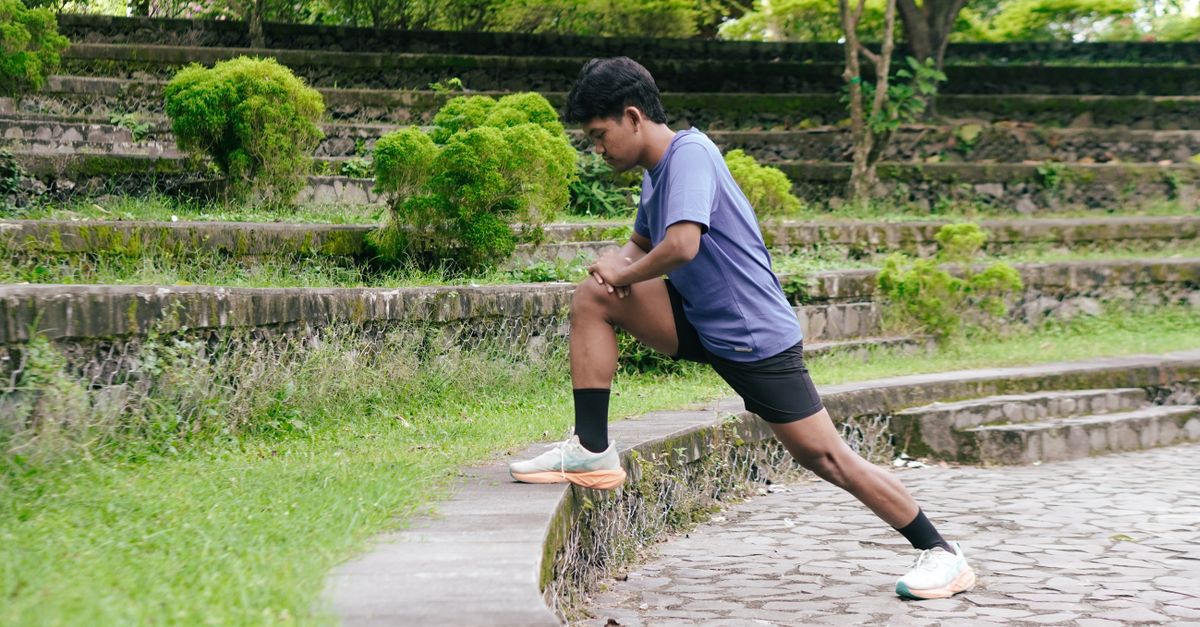
Hamstring tendonitis is irritation of the tendons that connect the hamstring muscles to the pelvis at the sit bone, or to the lower leg just behind the knee. It causes deep, localized pain that worsens with sitting on hard surfaces, running uphill, and bending forward with straight legs. The condition develops when tendon load increases faster than the tendon can adapt, and it improves with load management and gradual strengthening rather than rest alone. A felt pop, bruising, numbness down the leg, or pain that is not improving warrants evaluation by a clinician.
If sitting through a meeting, a long car ride, or dinner on a wooden chair leaves you with a deep ache right at the bone you sit on, hamstring tendonitis may be the reason. The same type of pain can also show up behind the knee, or flare the morning after a hilly run or a weekend of heavy yard work. It is stubborn because the things that feel like they should help, such as deep stretching or sitting still, can make it worse.
This guide is for anyone dealing with hamstring tendon pain, whether you run, work at a desk, or recently ramped up activity after time off. It focuses on the tendon itself. If your discomfort is spread through the muscle rather than pinpointed at the sit bone or knee, our guide to massage for hamstring pain covers general tightness and strain. The sections below cover where the pain comes from, why hard chairs aggravate it, how to manage load, where a massager fits, and when to see a clinician.
Where Hamstring Tendon Pain Comes From
The hamstrings are three muscles running down the back of the thigh: the biceps femoris, semitendinosus, and semimembranosus. Mayo Clinic describes tendinitis as inflammation or irritation of a tendon, the thick fibrous cord that attaches muscle to bone. Long-standing tendon pain often involves changes in the tendon's structure more than classic inflammation, which is why the term tendinopathy is now widely used.
Pain at the Sit Bone
High hamstring tendinopathy, also called proximal hamstring tendinopathy, affects the shared tendon where the hamstrings attach to the ischial tuberosity. That is the bony point you feel under each buttock when you sit. The pain sits deep in the lower buttock and is usually easy to point to with one finger.
It tends to ease slightly once you are warmed up and moving, then return afterward or the next morning. That pattern can be misleading, because feeling fine mid-run does not mean the tendon tolerated the load.
Pain Behind the Knee
Distal hamstring tendinopathy affects the tendons that cross the back of the knee. The biceps femoris tendon runs along the outer back of the knee, while the semitendinosus and semimembranosus tendons attach on the inner side. Pain here can flare with running, kicking, or bending the knee against resistance. It needs to be separated from other causes of back-of-knee pain, such as a Baker's cyst or a calf strain.
Why Hard Chairs Make It Worse
When you sit, your body weight presses the ischial tuberosity, and the tendon wrapped around it, into the seat. A hard chair concentrates that pressure on a small area. Leaning forward or crossing your legs adds hip flexion, which pulls the tendon tighter against the bone. That combination of compression and stretch is what makes a long drive or a wooden bench so uncomfortable.
Typical signs of proximal hamstring tendon pain include:
- A deep ache at the sit bone that builds the longer you sit
- Pain when bending forward with straight knees, such as reaching for the floor
- Discomfort when running uphill or accelerating
- Stiffness first thing in the morning or after a period of rest
- Tenderness when pressing directly on the tendon attachment
What Causes Hamstring Tendonitis?
Tendons adapt to load slowly, far more slowly than muscle does. Hamstring tendon pain tends to appear when the demand on the tendon rises faster than it can adapt, rather than from a single dramatic injury.
Running, Hills, and Speed Work
Running uphill keeps the hip in a flexed position while the hamstrings work hard to extend it. That loads the proximal tendon exactly where it wraps around the sit bone. Sprinting, speed intervals, and overstriding place similar demands on the tendon.
This is why high hamstring tendinopathy is closely associated with distance running. It is not limited to runners, though, and it can develop in anyone whose daily load on the hamstrings changes quickly.
Sudden Increases in Activity
A jump in weekly mileage, a new hill route, returning to sport after time off, or a weekend of heavy gardening can all overload a tendon conditioned for less. Pain often appears a day or two after the change, which makes the trigger easy to miss. Other contributing factors include:
- Long periods of sitting on hard surfaces
- Deep, sustained hamstring stretches that compress the tendon against the bone
- Weak gluteal muscles, which shift more work onto the hamstrings
- Lunges, deadlifts, or deep squats added without a gradual build-up
- A previous hamstring strain on the same side
Load Management for Hamstring Tendonitis
Complete rest rarely resolves tendon pain, because tendons need load to rebuild their capacity. The goal of load management is to reduce the positions that irritate the tendon while keeping it working at a level it tolerates.
Calm the Compressive Positions
In the early phase, cut back on activities that combine hip flexion with tendon stretch. Practical changes include:
- Sitting on a cushioned seat, or a cushion with a cutout that offloads the sit bones
- Standing up and moving every half hour or so during desk work
- Pausing deep forward folds and hamstring stretches held at end range
- Swapping hills and speed work for flat, easy activity that does not provoke pain
- Avoiding sitting with your legs crossed
Use Pain as a Guide
A reasonable working rule is to keep pain during and after activity mild, around 3 out of 10 or lower, and to make sure it settles by the next morning. If symptoms are worse the following day, the load was too much and should be scaled back. This approach keeps you active without repeatedly re-irritating the tendon.
Build Capacity Gradually
Rehab for tendon pain generally progresses through stages, ideally guided by a physical therapist:
- Isometric holds, such as a bridge held still with the knees bent, to load the tendon without movement.
- Slow strengthening through a comfortable range, such as bridges, hamstring curls, and hip extension.
- Heavier, longer-range strengthening as tolerance improves, adding hip flexion only gradually.
- Faster loading, such as hill running or sprinting, reintroduced last.
Tendon remodeling takes time. Expect progress to be measured in weeks to months rather than days.
Where Massage Fits for Tendon Pain
Massage is not a fix for an irritated tendon, but it can play a supporting role alongside load management. The key is where you apply it.
Target the Muscle, Not the Tendon
Never apply firm pressure directly on the irritated tendon at the sit bone. Pressing into a tendon that is already compressed and sensitive adds the same kind of load that makes sitting painful. Instead, work the middle of the hamstring muscles, roughly halfway between the buttock and the back of the knee, where the muscle belly is thickest.
If your pain is behind the knee, the same principle applies. Stay above the knee crease and keep any massage on the mid-thigh.
Oscillation vs. Vibration Massagers
Many massagers are sold as vibration massagers, and vibration is the term you will see most often when shopping. MedMassager uses oscillating technology to deliver deeper, more controlled vibration than conventional massagers. The Body Massager oscillates in a circular motion through a large, soft, cushioned contouring pad that forms to the back of the thigh, spreading that movement across the muscle rather than concentrating it on one point.
For the muscles surrounding an irritated hamstring tendon, this matters. Deep oscillation moves surrounding muscle tissue, helping increase blood flow in areas that are stiff or overused. The Body Massager is an FDA-registered Class I medical device, and you can compare the Classic and Plus models in the MedMassager Body Massager collection.
What Massage Won't Do
Keep expectations grounded. A massager supports blood flow and comfort in the muscle, but it does not rebuild tendon capacity.
- It can help the hamstring muscles feel less tight after sitting or activity.
- It can serve as a comfortable warm-up before rehab exercises.
- It does not replace progressive strengthening.
- It does not substitute for evaluation if red-flag symptoms appear.
For a side-by-side look at device options for this area, see our guide to choosing the best massager for hamstrings.
Using the Body Massager on Your Hamstrings
The Body Massager is a handheld unit with easy-to-hold, slip-resistant handles, so you can position the pad yourself while seated or lying down. Because sitting on the sit bone can aggravate proximal tendon pain, set up so the pad reaches the back of your thigh without you sitting on it. The circular oscillating action creates continuous, repetitive movement in the hamstring muscle, which supports blood flow in tissue that is stiff or overused.
- Sit on the edge of a couch or bed with the affected leg extended and supported on an ottoman, or lie on your side with the affected leg on top.
- Hold the cushioned pad against the middle of the hamstring, halfway between the buttock and the knee. Do not rest your body weight on the unit.
- Start with about 10 minutes at the lowest setting, once or twice a day.
- Move the pad slowly along the muscle belly, staying well below the sit bone and above the back of the knee.
- Increase intensity only if the area feels comfortable during the session and the next morning.
- Stop if you feel sharp pain, pain spreading toward the sit bone, or tingling down the leg.
A session before isometric or strengthening exercises, or after a long stretch of sitting, fits naturally into the day. The handheld body massager with a cushioned pad can be applied across the calves, thighs, and hamstrings, though the lower glute area closest to the sit bone should be avoided while the tendon is sensitive. You can also browse the full MedMassager catalog to see each product and how it works.
If you are working with a physical therapist, ask whether massage fits your current rehab phase and how it should be timed around your exercises.
When to See a Clinician
Tendon pain that improves steadily with sensible load changes can often be managed at home. Some symptoms, however, point to a different or more serious problem.
Red-Flag Symptoms
See a doctor, sports medicine physician, or physical therapist if you notice any of the following:
- A sudden pop or tearing sensation in the back of the thigh, especially during sprinting or a slip
- Bruising down the back of the thigh after an injury
- Difficulty walking or bearing weight
- Numbness, tingling, or burning that travels down the leg
- Pain that wakes you at night or is present at complete rest
- No improvement after two to three weeks of reduced load
- Swelling, warmth, or fever
What an Evaluation Involves
A clinician can examine the tendon, rule out a partial tear or avulsion, and order imaging such as ultrasound or MRI if needed. They can also check for other sources of buttock and thigh pain, including lumbar spine problems, sciatic nerve irritation, and ischial bursitis.
Mention any recent prescriptions, since fluoroquinolone antibiotics are associated with tendon problems. If you have diabetes, a bleeding disorder, or take blood thinners, ask your care team before using any massager on the leg.
Frequently Asked Questions
How long does hamstring tendonitis take to heal?
Recovery time depends on how long symptoms have been present and how consistently load is managed. Mild, recent cases can settle within a few weeks, while long-standing high hamstring tendinopathy can take several months of progressive strengthening. Returning to hills or sprinting too early is a frequent cause of setbacks.
Why does my hamstring tendon hurt when I sit?
Sitting presses the ischial tuberosity, and the tendon attached to it, directly into the seat. Hard chairs concentrate that pressure, and leaning forward adds stretch that pulls the tendon tighter against the bone. A cushioned seat and regular breaks from sitting reduce that compression.
Should I stretch with high hamstring tendinopathy?
Deep hamstring stretching tends to aggravate proximal tendon pain because it pulls the tendon tightly against the sit bone. Gentle movement within a comfortable range is generally fine, but sustained stretches into a deep forward bend are best paused while symptoms are active. Progressive strengthening does more for tendon capacity than stretching.
Can I keep running with hamstring tendon pain?
Running on flat ground at an easy pace may be tolerable if pain stays mild and settles by the next morning. Hills, speed work, and long strides load the tendon most heavily and are usually the first things to pause. If pain increases from one day to the next, reduce volume further and consider a physical therapy assessment.
What is the difference between a hamstring strain and tendinopathy?
A hamstring strain is a tear in the muscle fibers, typically with sudden onset during sprinting or a slip, and it often causes bruising. Tendinopathy develops gradually from repeated load and produces pain localized at the sit bone or behind the knee. Because the two are managed differently, a clinician should evaluate any sudden injury.
Can a massager help with hamstring tendon pain?
A massager can support comfort in the surrounding muscle, but it should be applied to the middle of the hamstring rather than the irritated tendon at the sit bone. Deep oscillation moves surrounding muscle tissue, helping increase blood flow in areas that are stiff or overused. It works best as a complement to load management and strengthening, not a replacement for them.
The Bottom Line
Hamstring tendonitis is a load problem at its core: pain at the sit bone or behind the knee that flares with hard chairs, hills, and sudden jumps in activity. Calming compressive positions, using pain as a guide, and rebuilding strength gradually form the foundation. Bring in a clinician if red-flag symptoms appear or progress stalls.
A massager can support muscle comfort when the cushioned pad stays on the middle of the hamstring and away from the tendon itself. The circular oscillating action keeps the muscle tissue moving, which supports blood flow in areas that are stiff or overused. If that fits your plan, explore the Body Massager for leg use alongside whatever your care team has recommended.
This content is for informational purposes only and is not intended as medical advice, diagnosis, or treatment. Always consult a qualified healthcare professional before starting any new treatment or therapy. MedMassager products are FDA-registered Class I medical devices.


