
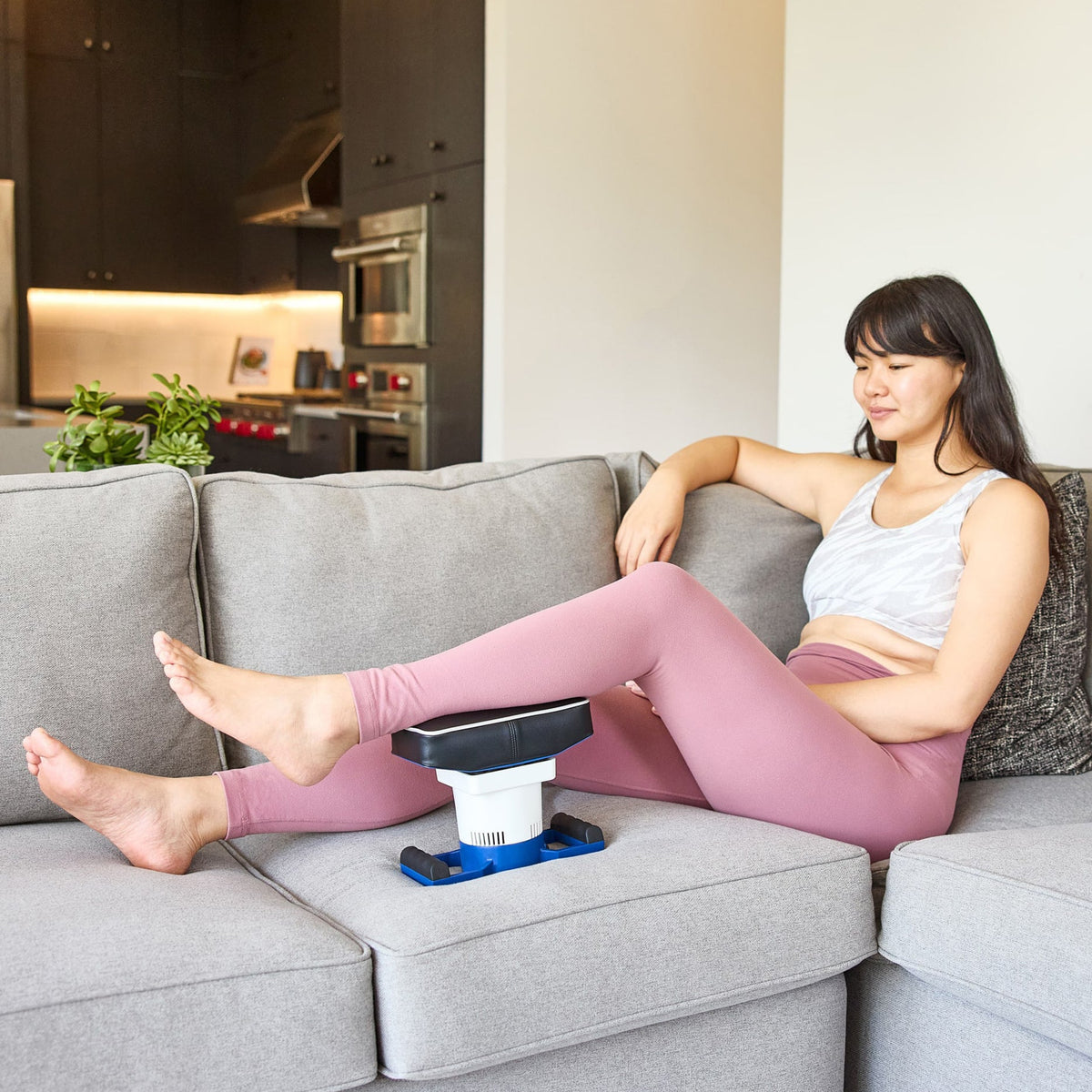
The best massager for hamstrings covers a large muscle group with one broad, cushioned contact surface. It also offers adjustable intensity and can be used while you rest instead of being held at an awkward angle behind your leg. A handheld body massager with a large contouring pad that oscillates in a circular motion fits these requirements because the pad can sit directly under the back of the thigh while you lie down or sit. Small-headed tools and foam rollers can work, but they cover less area at a time and take more effort to position.
If you've tried to work out a tight hamstring with a tennis ball or a narrow massage gun, you already know why finding the best massager for hamstrings is harder than it sounds. The back of the thigh is hard to reach, the muscle is large, and holding a tool there for more than a minute gets tiring. The tool has to cover a lot of muscle, and it has to stay in place without you twisting around to hold it.
This guide is for desk workers whose hamstrings stiffen from sitting, people who walk or run regularly and feel soreness afterward, and anyone managing a mild strain who wants a simple at-home option between appointments. If you want hands-on approaches instead of a device, our guide to manual massage techniques for hamstring pain covers those in detail. Below, you'll find what causes hamstring tightness, how oscillating massage works on a large muscle group, what to compare when shopping, and a step-by-step routine for lying down or seated use.
Why Hamstrings Get Tight and Sore
Hamstring discomfort usually comes from one of three situations: long periods of sitting, repetitive activity, or an actual strain. Knowing which one applies to you shapes how you use any massager.
Hamstring Anatomy in Brief
Cleveland Clinic describes the hamstrings as a group of three muscles running down the back of the thigh: the biceps femoris, the semitendinosus, and the semimembranosus. They start at the sitting bone of the pelvis and cross the back of the knee. Together they bend the knee and extend the hip, so they work during walking, climbing stairs, and standing up from a chair.
Because they span two joints, the hamstrings are affected by both hip and knee position. That makes them especially sensitive to how you sit and how you move.
Prolonged Sitting
When you sit, your knees are bent and your hamstrings stay in a shortened position for hours. The back of the thigh is also pressed against the chair seat, which compresses the tissue and slows blood flow through the area. Many people who work at desks notice that their hamstrings feel stiff and resist stretching by the end of the day, even when they haven't exercised at all.
Running, Walking, and Repetitive Activity
Sore hamstrings after running or long walks are common because the muscles decelerate the lower leg with every stride. That repeated braking produces fatigue and the familiar ache that shows up later in the day or the next morning. Hill walking, stair climbing, and gardening that involves bending at the hips can produce the same effect.
Hamstring Strains
A hamstring strain is an overstretch or tear of the muscle fibers, often felt as a sudden pull during a quick movement. Mayo Clinic describes hamstring injuries as ranging from mild strains to more serious tears. Common signs of a strain include:
- Sudden, sharp pain at the back of the thigh during activity
- Tenderness when pressing on the muscle
- Bruising that appears over the following days
- Pain when straightening the leg or bending forward
Mild strains often settle with rest and gradual activity, while severe ones need medical evaluation. A massager is a tool for tightness and soreness, not a replacement for that evaluation.
How Oscillating Massage Helps Hamstrings
A massager works on the hamstrings by moving muscle tissue mechanically while you stay relaxed. The type of motion and the size of the contact surface determine how well that works on a muscle group this large.
Circular Oscillation on a Large Muscle Group
The MedMassager Body Massager oscillates in a circular motion, combining vibration with circular rotation. For thigh and hamstring pain, deep oscillation increases local blood flow in large muscle groups, supporting recovery during rest. This matters for the hamstrings in particular, because sitting compresses the back of the thigh and leaves the tissue still for long stretches.
The circular oscillating action moves the whole area under the pad rather than striking one small point. As a result, you can relax completely while the device does the work, which suits people whose hamstring tightness comes from inactivity rather than injury.
Why the Contact Surface Matters
The Body Massager uses a large, soft, cushioned contouring pad that forms to the body. On the back of the thigh, that means the pad conforms to the curve of the muscle instead of pressing a hard point into it. You can browse the MedMassager body massager collection to compare the Classic and Plus models, both of which use this pad design with variable speed control.
Massager vs. Manual Techniques
Manual approaches offer precise pressure and direct feedback from whoever is doing the work. They include:
- Self-massage with your hands or thumbs
- A partner working along the back of the thigh
- Sessions with a licensed massage therapist
Each of these takes effort, time, or appointments. A handheld massager fills a different role: it gives you consistent, repeatable sessions at home without needing a second person or a strong grip.
Many people use both. A therapist works on specific problem spots during appointments, and a massager handles daily maintenance in between.
What Makes the Best Massager for Hamstrings
Not every massager suits a muscle group that is long, thick, and located where you can't easily see or reach it. These are the features worth comparing before you buy.
Key Features to Compare
- Coverage area: A broad contact surface treats more of the thigh at once and requires fewer repositioning adjustments.
- Adjustable intensity: Variable speed lets you start gently on sore tissue and increase as the muscle loosens.
- Positioning: The best option can rest under your leg while you lie down or sit, so your arms and back aren't strained.
- Grip: Easy-to-hold, slip-resistant handles make it simpler to move the unit along the thigh.
- Versatility: A device that also works on the calves, glutes, hips, and lower back gives you more use from a single purchase.
Vibration vs. Oscillation for Large Muscles
Many shoppers search for a vibration massager for their legs, and vibration is the right category to start with. The difference lies in how that vibration is delivered. MedMassager uses oscillating technology to deliver deeper, more controlled vibration than conventional massagers, with a circular oscillating action that moves the muscle tissue under the pad rather than buzzing on the surface.
For a muscle as thick as the hamstring, that depth of movement is the deciding factor. For a muscle this thick, a broad pad with circular oscillation spreads movement across a large area of tissue.
How Common Massager Types Compare
| Tool | How It Works | Hamstring Fit |
|---|---|---|
| Oscillating body massager | Cushioned pad oscillates in a circular motion | Covers a large area; can rest under the thigh lying down or seated |
| Massage gun | Small head delivers rapid strikes to one spot | Covers a narrow area; must be held behind the leg |
| Foam roller | Your body weight presses the thigh into a cylinder | Requires floor work and arm strength; pressure is hard to control |
| Shiatsu massager | Rotating nodes, often inside an enclosed chamber | Usually shaped for the neck or back; awkward on the thigh |
| Vibration plate | Platform you stand on | Works the whole body rather than targeting the hamstrings |
If your hamstring tightness comes from sitting or daily activity, the professional-grade Body Massager options offer the best balance of coverage, depth, and ease of use.
How to Use a Massager for Hamstrings
The Body Massager pad is applied directly to the back of the thigh. For hamstring tightness, the goal is steady circular oscillation that supports blood flow through the large muscle group while you rest. Choose whichever position is most comfortable for you.
Lying Down Routine
- Lie on your back on a bed or couch with one knee slightly bent.
- Place the cushioned pad under the back of your thigh, about midway between the knee and the buttock.
- Start on the lowest intensity setting and let your leg relax fully onto the pad.
- After a few minutes, move the pad closer to the sitting bone, then toward the back of the knee, avoiding the knee crease itself.
- Increase intensity gradually only if the sensation stays comfortable.
- Switch legs and repeat.
Seated Routine
- Sit in a sturdy chair with your feet flat on the floor.
- Rest the pad on the seat and position the back of your thigh on top of it, the same way you might rest the pad between your back and the back of a chair.
- Begin on low intensity and keep the rest of your body relaxed.
- Shift your leg slightly every few minutes so the pad reaches different sections of the muscle.
- Repeat on the other leg.
Frequency and Intensity
A reasonable starting point is 10 to 15 minutes per leg, once or twice a day, on a low or medium setting. Desk workers often get the most benefit from a session in the evening or during a long break from sitting. If you're sore after a long walk or run, a session later that day works well. Stop if you feel sharp pain, numbness, or tingling.
Special Considerations Before You Start
A massager is a sensible option for everyday tightness and soreness, but some situations call for caution or a conversation with a clinician first.
When to Hold Off
Avoid using any massager directly over a fresh hamstring injury and get it checked if you notice any of the following:
- A popping sensation at the moment of injury
- Significant bruising or visible swelling
- Difficulty walking or bearing weight
- Calf or thigh swelling with warmth and redness, which can signal a blood clot
Once a clinician confirms a mild strain is settling, you can ask whether gentle massage fits your plan. In that setting, the Body Massager's circular oscillating action creates continuous, repetitive movement in the thigh muscle, which supports circulation during use, alongside whatever your doctor has recommended.
Pain That Travels Down the Leg
Pain that starts in the lower back or buttock and runs down the back of the thigh may come from an irritated sciatic nerve rather than the hamstring muscle. Johns Hopkins Medicine describes sciatica as pain along the path of the sciatic nerve. If your symptoms include shooting pain, numbness, or weakness, see a healthcare provider before relying on massage.
Older Adults and People With Limited Mobility
Foam rolling and floor stretches can be difficult if getting down to the ground is a challenge. A massager used on a bed or in a chair removes that barrier. If you're looking for tools for other areas too, the full range of therapeutic massagers includes options for the feet and neck as well as the body.
Frequently Asked Questions
Why are my hamstrings always tight?
Constant hamstring tightness is often linked to long hours of sitting, which keeps the muscles shortened and compresses the back of the thigh. Repetitive activity like walking, running, or bending at the hips can add to it. If tightness comes with pain that travels down the leg, numbness, or weakness, a healthcare provider should rule out nerve involvement.
Is a massage gun or an oscillating massager better for hamstrings?
A massage gun targets one small spot and has to be held behind the leg, which many people find tiring. An oscillating body massager with a large cushioned pad covers more of the thigh at once, and its circular oscillating action moves the tissue under the pad while the unit rests beneath your leg as you lie down or sit. For broad hamstring tightness, the larger contact surface is usually more practical.
How long should I massage my hamstrings?
Ten to fifteen minutes per leg is a reasonable starting point for most people. Begin on a low setting and increase only if the sensation stays comfortable. Stop if you feel sharp pain, numbness, or tingling.
Can you massage a pulled hamstring?
You should avoid deep pressure directly on a fresh hamstring strain, especially if there is bruising, swelling, or difficulty walking. A healthcare provider can assess the injury and tell you when gentle massage is appropriate. Mild strains are often managed with rest and a gradual return to activity.
Does sitting all day cause tight hamstrings?
Sitting for long periods keeps your knees bent and your hamstrings in a shortened position. The chair seat also presses on the back of the thigh, which slows blood flow through the area. Standing up and walking regularly throughout the day helps reduce that stiffness.
Should I stretch before or after massaging my hamstrings?
Many people find stretching easier after massage because the muscle feels looser. Gentle stretches such as a seated forward reach or a lying hamstring stretch with a strap work well afterward. Keep stretches slow and stop before you feel pain.
The Bottom Line
The best massager for hamstrings covers a large muscle group, offers adjustable intensity, and stays in position while you lie down or sit. Small-headed tools and foam rollers can help, but they demand more effort and reach less of the thigh at a time.
The MedMassager Body Massager, an FDA-registered Class I medical device, uses a cushioned contouring pad that oscillates in a circular motion to move deep tissue across the back of the thigh. Pair it with regular movement breaks and gentle stretching, and check with a clinician for any acute injury. To compare models, explore the Body Massager lineup for tight hamstrings.
This content is for informational purposes only and is not intended as medical advice, diagnosis, or treatment. Always consult a qualified healthcare professional before starting any new treatment or therapy. MedMassager products are FDA-registered Class I medical devices.


