
Shoulder arthritis is damage to the cartilage or inflammation of the joint lining inside the shoulder. It causes a deep ache, stiffness, lost range of motion, and grinding when the arm moves. The two main forms are osteoarthritis, a gradual wearing away of cartilage, and rheumatoid arthritis, an autoimmune disease that inflames the joint lining. A doctor diagnoses it with a physical exam, X-rays, and sometimes blood tests, and treatment ranges from exercise and physical therapy to medication, injections, and joint replacement surgery.
Reaching for a high shelf, fastening a seatbelt, or rolling onto your side at night can start to bring a deep, grinding ache. When that ache keeps returning, shoulder arthritis may be part of the picture. The pain often builds slowly, so it is easy to blame a bad night's sleep or a strained muscle until the stiffness stops going away.
This guide is for you if you've noticed your shoulder getting tighter and louder with age, if you've recently been told you have osteoarthritis or rheumatoid arthritis in the joint, or if you help care for someone who has. It explains what is happening inside the joint and how the two main types differ. It also shows how to tell routine stiffness from a warning sign. Below, you'll find the causes and symptoms, how a doctor confirms the diagnosis, treatment options, gentle exercises, where massage fits, and the red flags that need prompt medical care.
What Causes Shoulder Arthritis?
The shoulder is not a single joint. It is a group of structures that lets the arm move through a wider arc than any other joint in the body, and arthritis can develop in more than one of them. Where the damage sits shapes where you feel the pain.
Two Joints, Two Pain Patterns
Two joints in the shoulder are prone to arthritis:
- Glenohumeral joint: the ball-and-socket joint where the head of the upper arm bone (humerus) sits in a shallow socket on the shoulder blade (glenoid). Arthritis here tends to cause a deep ache felt toward the back of the shoulder.
- Acromioclavicular (AC) joint: the small joint where the collarbone meets the top of the shoulder blade (acromion). Arthritis here causes pain on top of the shoulder, especially when you reach across your body.
Osteoarthritis in the Shoulder
Mayo Clinic describes osteoarthritis as the most common form of arthritis. It occurs when the protective cartilage that cushions the ends of bones wears down over time. In the shoulder, the smooth cartilage on the ball and socket thins and roughens until bone surfaces begin to rub.
The body responds by forming bone spurs (osteophytes) around the joint edges, and the joint capsule can thicken and tighten. Age is the main risk factor. Others include an earlier dislocation or fracture, years of heavy overhead work, and a family history of arthritis.
Rheumatoid Arthritis and Other Types
The National Institute of Arthritis and Musculoskeletal and Skin Diseases, part of NIH, describes rheumatoid arthritis as an autoimmune disease in which the immune system attacks the lining of the joints. That lining, called the synovium, swells and over time can erode cartilage and bone. Several other forms can also affect the shoulder:
- Post-traumatic arthritis, which develops after a fracture or dislocation
- Rotator cuff tear arthropathy, which follows a large, long-standing rotator cuff tear
- Avascular necrosis, in which reduced blood supply damages the bone of the humeral head
Symptoms: Deep Ache, Stiffness, and Grinding
Arthritis in the shoulder usually develops gradually, and the symptoms tend to worsen with activity. The first sign is often a deep, dull ache inside the joint that gets worse after use and may wake you at night, especially when you lie on the affected side. Stiffness follows, making it harder to reach overhead, behind your back, or out to the side.
As cartilage thins, you may notice grinding, clicking, or catching (crepitus) when the arm moves. Over time the shoulder can also grow weaker, mostly because pain leads you to use it less. The two main types tend to behave differently:
- Osteoarthritis often affects one shoulder, usually the dominant one, and stiffness eases within a short time of getting moving.
- Rheumatoid arthritis tends to affect both shoulders, often alongside the hands, wrists, or feet, and brings morning stiffness that can last an hour or longer, sometimes with visible swelling and fatigue.
How Doctors Diagnose Shoulder Arthritis
Shoulder pain has many possible sources, including rotator cuff problems, frozen shoulder, and pain referred from the neck. A clear diagnosis guides every treatment decision that follows. The evaluation usually moves through these steps:
- History: when the pain started, what makes it worse, any past injuries, and whether other joints hurt.
- Physical exam: checking active and passive range of motion, strength, tenderness, and grinding as the arm moves.
- X-rays: the standard test, showing joint space narrowing, bone spurs, and changes in bone shape.
- Blood tests: markers such as rheumatoid factor, anti-CCP antibodies, and inflammation levels when rheumatoid arthritis is suspected.
- Advanced imaging: MRI or CT when the rotator cuff or bone structure needs a closer look.
A diagnostic injection of numbing medicine into a specific joint may also help confirm the source of the pain.
Treatment Options for Arthritic Shoulders
Treatment usually starts conservatively and steps up only if symptoms keep limiting daily life. Rheumatoid arthritis adds a second goal, controlling the underlying immune activity, which is managed by a rheumatologist.
Activity Changes and Physical Therapy
Adjusting how you lift, reach, and sleep can lower daily strain on the joint. A physical therapist designs exercises that keep range of motion and strengthen the rotator cuff and shoulder blade muscles, which helps support the joint. Heat before activity and ice after flare-ups are simple tools to discuss with your therapist.
Medications and Injections
Your doctor may suggest over-the-counter or prescription anti-inflammatory medication, depending on your health history. Corticosteroid injections can calm inflammation inside the joint. For rheumatoid arthritis, disease-modifying medications (DMARDs) and biologics target the immune process itself.
Surgical Options
When pain and stiffness persist despite conservative care, an orthopedic surgeon may discuss surgery. Options include:
- Arthroscopic debridement to clean out loose fragments and inflamed tissue
- Resection of the end of the collarbone for AC joint arthritis
- Total shoulder replacement, which replaces the ball and socket
- Reverse shoulder replacement, often used when the rotator cuff is also badly damaged
Where Massage Fits for Shoulder Arthritis
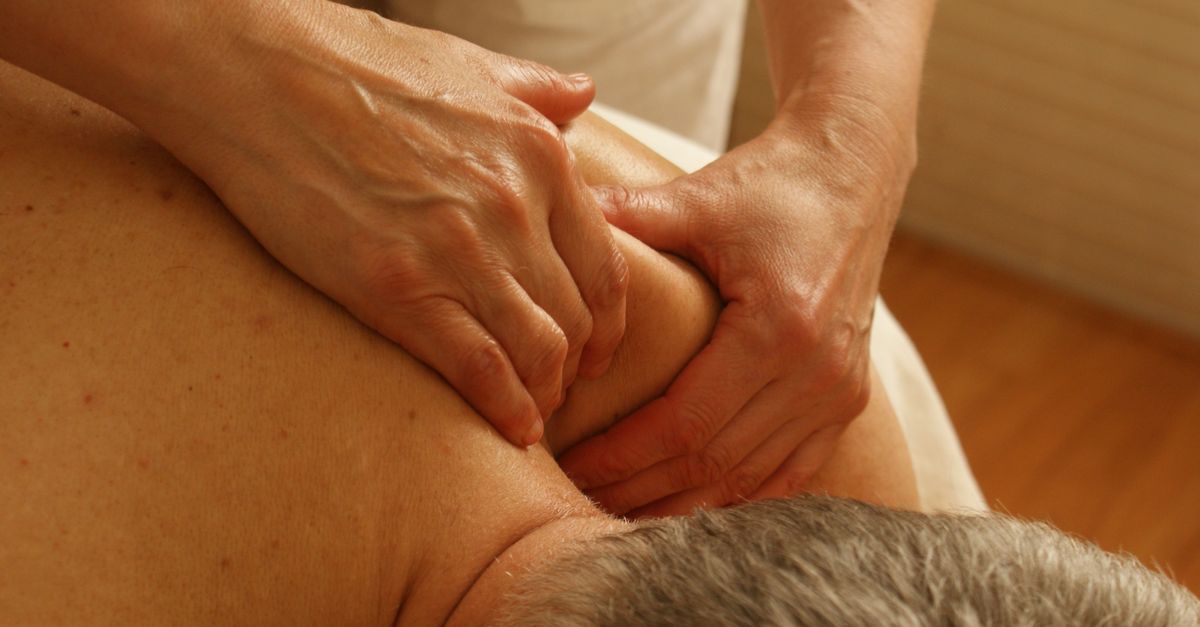
Massage cannot rebuild cartilage or change what an X-ray shows. What it can address is the muscle around the joint. When a shoulder hurts, the trapezius, deltoid, rhomboids, and rotator cuff muscles tend to guard and tighten, and that tension adds its own layer of soreness on top of the joint pain.
What Massage Can and Can't Do
Massage focused on the surrounding muscles can help them loosen before stretching and make movement feel less restricted. It is not a substitute for the medical treatment above. Use it alongside whatever your doctor or physical therapist has recommended. For a broader look at the topic, see our article on whether massage helps with arthritis.
Keep these limits in mind:
- Never press on a swollen, hot, or red joint.
- Work the muscles around the shoulder, not directly into the bony joint.
- Skip massage during an active rheumatoid arthritis flare unless your care team says otherwise.
Body Massager for the Upper Back and Shoulder Muscles
Conventional vibration massagers rely on a motor shaking the unit. MedMassager uses oscillating technology to deliver deeper, more controlled vibration than conventional massagers. The MedMassager Body Massager with its cushioned contouring pad oscillates in a circular motion, and the pad forms to the body. You can place it on the muscles across your upper back, around the shoulder blade, and along the outer upper arm.
For the stiffness that builds around an arthritic shoulder, mechanical movement stimulates muscle tissue, helping circulate blood through areas that commonly tighten. The Body Massager is an FDA-registered Class I medical device with adjustable intensity. It can be used seated or lying down, including resting it between your back and the back of a chair, so you don't have to reach with a sore arm.
Neck Massager for the Upper Shoulders
The upper trapezius, the muscle running from the base of the neck to the top of the shoulder, often tightens when a painful shoulder changes how you hold your arm. The Neck Massager with built-in heat is applied across this area. Its massage nodes mimic hand kneading on the trapezius muscle, helping loosen tissue that tightens from poor posture or extended screen time, and the dual-direction rotation targets the surrounding upper back muscle tissue.
Exercises and a Daily Shoulder Routine
Gentle, regular movement is one of the most useful things you can do for an arthritic shoulder. Have your doctor or physical therapist confirm these exercises suit your joint before you start, and stop any movement that causes sharp pain.
Gentle Range-of-Motion Exercises
- Pendulum swings: lean on a table with your good arm, let the sore arm hang, and make 10 small circles in each direction.
- Table slides: sit beside a table, rest your forearm on a towel, and slide it forward until you feel a mild stretch. Repeat 10 times.
- Wall walks: face a wall and walk your fingers upward as far as is comfortable, then walk them back down. Repeat 5 to 10 times.
- Assisted external rotation: hold a stick or cane with both hands, elbows at your sides, and use the good arm to gently push the sore arm outward. Repeat 10 times.
- Cross-body stretch: use your opposite hand to gently draw the sore arm across your chest and hold for 20 to 30 seconds. Skip this one if it irritates an arthritic AC joint.
Putting It Into a Daily Routine
Pairing muscle work, movement, and rest gives your shoulder a predictable rhythm. The Body Massager's circular oscillating action creates continuous, repetitive movement in the muscle tissue, which supports circulation around the joint during use. Here is a reasonable starting point:
- Warm up the surrounding muscles with a heat pack or the Neck Massager's built-in heat on the upper shoulders for about 10 minutes.
- Apply the Body Massager pad to the upper back and around the shoulder blade, avoiding any swollen joint. Start with about 10 minutes at the lowest setting, once or twice a day.
- Follow with your range-of-motion exercises while the muscles are warm.
- Ice the joint for 15 minutes afterward if it feels irritated.
To compare the oscillating Body Massager with the heated Neck Massager in one place, browse the MedMassager catalog.
When Shoulder Pain Needs Prompt Care
Arthritis pain usually changes slowly. A sudden shift in how your shoulder looks or feels is a reason to call a doctor rather than adjust your home routine.
Red Flags
Seek medical care promptly if you notice any of the following:
- A hot, red, swollen joint, especially with fever or chills, which can signal a joint infection
- Sudden severe pain or an inability to lift the arm after a fall
- A visible deformity of the shoulder
- Numbness, tingling, or weakness spreading down the arm
- Left shoulder or arm pain together with chest pressure, shortness of breath, or sweating, which needs emergency care
Arthritis Versus Frozen Shoulder
Frozen shoulder (adhesive capsulitis) also causes pain and stiffness, but it comes from a thickened, tightened joint capsule rather than cartilage loss. It typically moves through freezing, frozen, and thawing phases, and X-rays usually look normal. If you're weighing that diagnosis, our guide to massagers for frozen shoulder covers that condition in detail.
Rheumatoid Arthritis Flares and Heat
Heat can feel good on stiff muscles, but it may worsen a joint that is actively inflamed. During a rheumatoid arthritis flare, cold is often the better choice for the joint itself. Ask your rheumatologist how to handle heat and massage when your joints are swollen.
Frequently Asked Questions
What does shoulder arthritis feel like?
It usually feels like a deep, dull ache inside the joint that worsens with use and may wake you at night. The shoulder often feels stiff, especially when reaching overhead or behind your back. Grinding, clicking, or catching during movement is also typical as cartilage wears down.
Is heat or ice better for an arthritic shoulder?
Heat is generally useful before activity because it loosens stiff muscles and makes movement easier. Ice works better after activity or when the joint feels irritated, because cold reduces swelling. Avoid heat on a joint that is hot, red, or swollen, and use ice instead.
Can you massage an arthritic shoulder?
You can massage the muscles around an arthritic shoulder, such as the trapezius, upper back, and deltoid, which tend to tighten in response to joint pain. Avoid pressing directly into the joint, and never press on a joint that is swollen, warm, or red. Check with your doctor first if you have rheumatoid arthritis or a recent injury.
What exercises should you avoid with shoulder osteoarthritis?
Heavy overhead pressing, behind-the-neck movements, and deep dips tend to load a worn shoulder joint and can aggravate pain. Avoid forcing a stretch past sharp pain. A physical therapist can tailor a plan that keeps you moving without irritating the joint.
How do you tell rheumatoid arthritis from osteoarthritis in the shoulder?
Osteoarthritis usually affects one shoulder and brings stiffness that eases soon after you start moving. Rheumatoid arthritis tends to affect both shoulders along with other joints, and it causes longer morning stiffness, swelling, and fatigue. A doctor confirms the difference with X-rays and blood tests.
When is shoulder replacement surgery considered?
Surgery is usually discussed when pain and stiffness keep limiting daily activities or sleep despite physical therapy, medication, and injections. An orthopedic surgeon reviews your imaging, rotator cuff health, and overall health before recommending an option. Total and reverse shoulder replacement are the two main joint replacement procedures.
The Bottom Line
Shoulder arthritis develops when cartilage wears down or the joint lining becomes inflamed, causing a deep ache, stiffness, and grinding. A doctor can confirm whether it is osteoarthritis or rheumatoid arthritis with an exam, X-rays, and blood tests. Treatment then builds from movement and physical therapy toward medication, injections, or surgery if needed.
Massage belongs with the surrounding muscles, never on a swollen joint, and works best alongside the plan your care team sets. The Body Massager's circular oscillating action moves the muscle tissue continuously, which supports circulation around the joint during use. To work on the tight muscles across your upper back and shoulder blade, explore body massagers for shoulder and upper back muscles.
This content is for informational purposes only and is not intended as medical advice, diagnosis, or treatment. Always consult a qualified healthcare professional before starting any new treatment or therapy. MedMassager products are FDA-registered Class I medical devices.


