
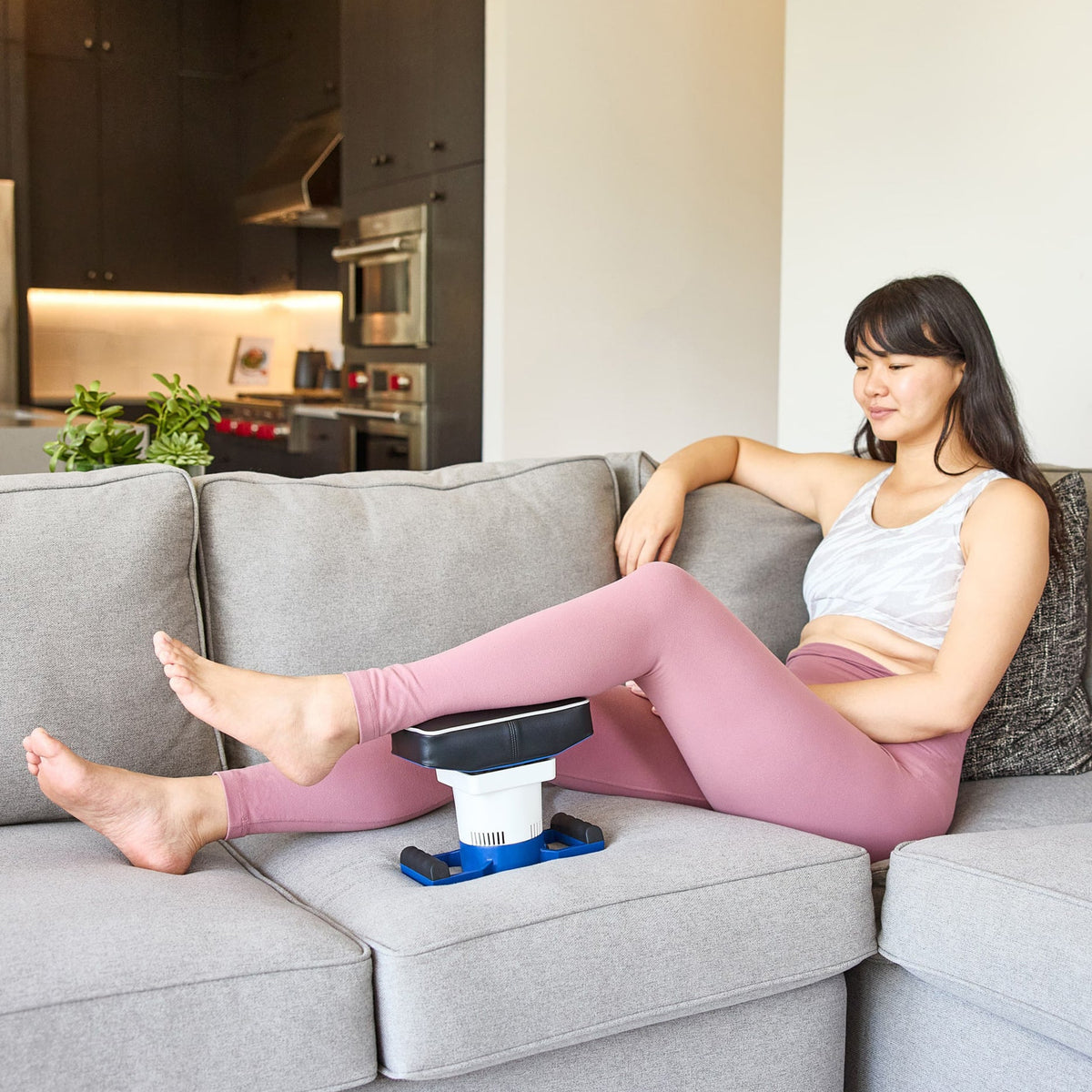
The best massager for hip pain is one built to reach the muscles surrounding the hip joint, including the glutes, hip flexors, and tensor fasciae latae (TFL), rather than the joint itself. A body massager with a large, cushioned massage pad and adjustable intensity lets these muscle groups rest directly against the pad for consistent, even contact. MedMassager's Body Massager uses circular oscillating motion to support local blood flow in muscle tissue that commonly tightens from sitting, walking imbalances, or overuse. Anyone diagnosed with hip arthritis or bursitis should confirm with a physician that massage is appropriate before adding it to a routine.
Two hours into a commute, the front of your hip starts to lock up. By the time you search for the best massager for hip pain, most of what turns up covers stretches and hand techniques rather than which device actually reaches the area. That's a different question. This guide is for people who already know massage helps and now need to know what to buy.
That might mean tight hip flexors after long drives, glute soreness from standing shifts, or ongoing management alongside a diagnosed condition like bursitis. MedMassager builds oscillating therapeutic massagers, and that experience shapes what we look for in a device meant to reach the hip comfortably and consistently. The right choice depends less on brand names than on whether the unit can reach the glutes, hip flexors, and outer hip with even, adjustable contact.
Why Hip Pain Often Starts in Muscles
Hip pain doesn't always originate in the joint itself. In many cases, the discomfort comes from the muscle groups that surround and stabilize the hip, and those muscles respond differently to massage than a joint would.
The Muscles Around the Hip Joint
The hip is stabilized by several muscle groups working together, and each reacts to prolonged sitting, standing, or overuse in its own way. The hip flexors in particular tighten from long hours in a chair. TFL tightness at the outer hip often refers pain down the outer thigh because it connects into the iliotibial band. The groups most often involved in muscular hip pain include:
- Gluteus maximus, medius, and minimus (hip extension and lateral stability)
- Hip flexors: iliopsoas and rectus femoris (hip flexion, often tight from sitting)
- Tensor fasciae latae, or TFL (outer hip stability, connects to the IT band)
- Piriformis and deep rotators (can contribute to referred pain near the sciatic nerve)
Arthritis, Bursitis, and Overuse
Mayo Clinic describes hip bursitis as inflammation of the fluid-filled sac that cushions the hip joint, which can cause pain on the outer hip that worsens with pressure or activity. Osteoarthritis of the hip involves gradual breakdown of the cartilage cushioning the joint, and it commonly causes stiffness alongside pain. Neither condition is caused by tight muscles. Even so, the muscles surrounding an irritated hip often tighten defensively, which adds a second, muscular layer of discomfort on top of the underlying joint issue.
Our guide to massage for hip pain covers the technique side in more detail. This article focuses on device selection.
How a Body Massager Helps with Hip Pain
Most people searching for a vibration massager for hip pain are picturing something that shakes or buzzes against sore muscle tissue. MedMassager uses oscillating technology to deliver deeper, more controlled vibration than conventional massagers, and that circular oscillating motion behaves differently against sore tissue than a simple shake.
Oscillation Versus Standard Vibration
A conventional vibrating massager typically relies on a motor shaking the entire unit, which produces surface-level sensation that doesn't always reach deeper muscle layers. Circular oscillating action moves more deliberately through the tissue. For muscle groups as large and layered as the glutes, that distinction matters. In practice, the oscillating motion:
- Engages the muscle tissue itself rather than only the skin surface
- Supports local blood flow in the glutes and hip flexors during use
- Can be adjusted up or down through multiple intensity settings as sensitivity changes
Working the Muscle, Not the Joint
Oscillation reaches deep muscle layers and supports local blood flow in muscles affected by prolonged sitting, which is exactly the pattern behind most hip flexor tightness. This is a muscle-tissue mechanism, not a joint treatment, and that distinction matters if you're managing arthritis or bursitis. If a physician has cleared you to use massage around an arthritic or bursitic hip, resting the glute and hip flexor muscles against the cushioned pad of a unit from the Body Massager collection, rather than pressing the bony point of the hip against it, keeps the focus on the muscle tissue supporting the joint. For guidance on targeting the hip flexors specifically, see our how to massage hip flexors breakdown.
Choosing the Best Massager for Hip Pain
Not every massager is built to reach the hip area well. Because the glutes, hip flexors, and TFL sit at awkward angles compared to the back or legs, pad shape and intensity range matter more here than they might for other muscle groups.
Pad Size and Shape
A large, cushioned contouring pad gives you room to reposition your hip and glute area without constantly readjusting. Enclosed massage chairs or narrow rollers often can't accommodate the angle needed to reach the outer hip or the front of the hip flexor.
Adjustable Intensity
Hip flexor and glute tissue varies a lot in sensitivity from person to person, and from day to day if there's an underlying condition involved. A massager with a real intensity range, rather than a limited range of adjustment, lets you start light around a tender bursitic hip and increase gradually as tolerated.
Comfort Across Different Positions
Because the hip sits at an angle relative to most massage pads, you'll want a unit you can settle into comfortably in whichever position lets the glute or hip flexor rest flat against the surface. Consider the following when comparing options:
- Does the pad stay in place when the hip rests against it at an angle?
- Can intensity be adjusted without stopping the session?
- Is the surface large enough to cover the glute muscle fully, not just a small point?
- Does the unit reach the outer hip and TFL area without constant repositioning?
Using a Body Massager for Hip Pain
Once you have a body massager suited to reaching the hip muscles, positioning and timing make the biggest difference in how effective a session feels. Deep oscillation moves surrounding muscle tissue, helping increase blood flow in areas that are stiff or overused, so the goal of each step is steady contact with the muscle, not the joint.
- Position yourself so the outer hip and glute rest directly against the cushioned pad, in whatever posture lets that muscle sit comfortably against it.
- Start on the lowest intensity setting for the first few minutes to gauge sensitivity, especially if you're managing arthritis or bursitis.
- Shift position every few minutes to cover the glute, the front hip flexor, and the outer TFL area separately.
- Keep sessions to a length that feels comfortable, generally in the 10 to 20 minute range, rather than pushing through discomfort.
- Use a consistent routine, several times per week, rather than a single long session.
If a specific angle or position isn't reachable, don't force it. The point is even, comfortable contact over the muscle group, not maximum pressure in one spot.
Arthritis, Bursitis, and Seeing a Doctor
Massage around the hip is generally about the surrounding muscle tissue, not the joint or bursa themselves, and that distinction becomes more important when a diagnosed condition is involved.
When to Loop in a Physician
A doctor or physical therapist can confirm whether your pain pattern is muscular, joint-related, or both, and can flag any positions or pressure levels to avoid. Talk with one before starting massage around the hip if you have any of the following:
- Diagnosed hip osteoarthritis
- Hip bursitis, especially right after a flare, when the area may be more sensitive to direct pressure
- A labral tear
- A recent hip replacement
Older Adults and Reduced Mobility
For older adults managing stiffness or reduced hip mobility, a handheld body massager with a cushioned pad is often easier to use than getting into and out of a massage chair or table. Mechanical movement stimulates muscle tissue, helping circulate blood through areas that commonly tighten, which is the reason to focus on the muscles around the joint. Shorter sessions at lower intensity, with a focus on the glutes and hip flexors rather than the joint line itself, tend to be the more comfortable starting point.
Frequently Asked Questions
What is the best massager for hip pain caused by tight muscles?
A body massager with a large, cushioned massage pad and adjustable intensity is generally the best fit, since it lets you position the glutes, hip flexors, or TFL directly against the massage surface. Devices that use circular oscillating motion reach deeper into muscle tissue than simple vibrating units, which matters for larger muscle groups like the glutes. The right choice depends on being able to comfortably reach the specific muscle causing your discomfort.
Can a massager help with hip bursitis pain?
A massager can address the muscle tissue surrounding a bursitic hip, but it does not treat or cure bursitis itself, since bursitis involves inflammation of a fluid-filled sac rather than the muscles. Anyone with diagnosed bursitis should confirm with a physician before using a massager near the affected area, and should avoid direct pressure on the point of the hip. Working the surrounding glute and hip flexor muscles at a gentle intensity is typically the more appropriate approach.
Does massage help hip arthritis?
Massage targets the muscles around the hip rather than the arthritic joint surface itself, so it does not reverse or treat the underlying joint changes involved in osteoarthritis. Some people find that working the surrounding muscle tissue helps with the muscle tightness that often accompanies joint stiffness. A physician or physical therapist is the right resource to confirm whether massage is appropriate for your specific case.
How often should I use a body massager on my hip?
Several short sessions per week, generally in the 10 to 20 minute range, tend to work better than one long session. Starting at a lower intensity and increasing gradually as tolerated gives the muscle tissue time to adjust, especially around a sensitive or previously injured hip. Consistency over time matters more than the length of any single session.
Is a vibration massager or an oscillating massager better for hip pain?
Standard vibration massagers typically shake the entire unit, which produces sensation mostly at the surface of the muscle. Circular oscillating motion moves more deliberately through deeper muscle layers and pairs well with adjustable intensity, so pressure can be matched to how the tissue feels that day. For larger muscle groups like the glutes and hip flexors, oscillation generally reaches tissue that surface-level vibration does not.
Should I massage the front or the back of my hip for hip flexor tightness?
Hip flexor tightness is typically addressed at the front of the hip and upper thigh, where the iliopsoas and rectus femoris muscles sit, rather than the back of the hip where the glutes are located. Positioning yourself so this front muscle group rests directly against the massage pad allows more even contact than trying to reach it from an awkward angle. If glute tightness is also present, that's a separate area worked with the glute resting against the pad.
Best Massager for Hip Pain: The Bottom Line
The best massager for hip pain isn't designed to work on the joint itself. It's built to comfortably and consistently reach the glutes, hip flexors, and TFL, the muscle groups that most often drive day-to-day hip discomfort. Look for a large, cushioned massage pad, real adjustable intensity, and a design that lets your hip muscles rest fully against it.
If arthritis or bursitis is part of the picture, a physician's input should come before any new routine. For managing muscle tightness around the hip, explore the MedMassager Body Massager collection. The circular oscillating action creates continuous, repetitive movement in the glute and hip flexor muscles, which supports circulation during use.
This content is for informational purposes only and is not intended as medical advice, diagnosis, or treatment. Always consult a qualified healthcare professional before starting any new treatment or therapy. MedMassager products are FDA-registered Class I medical devices.


