
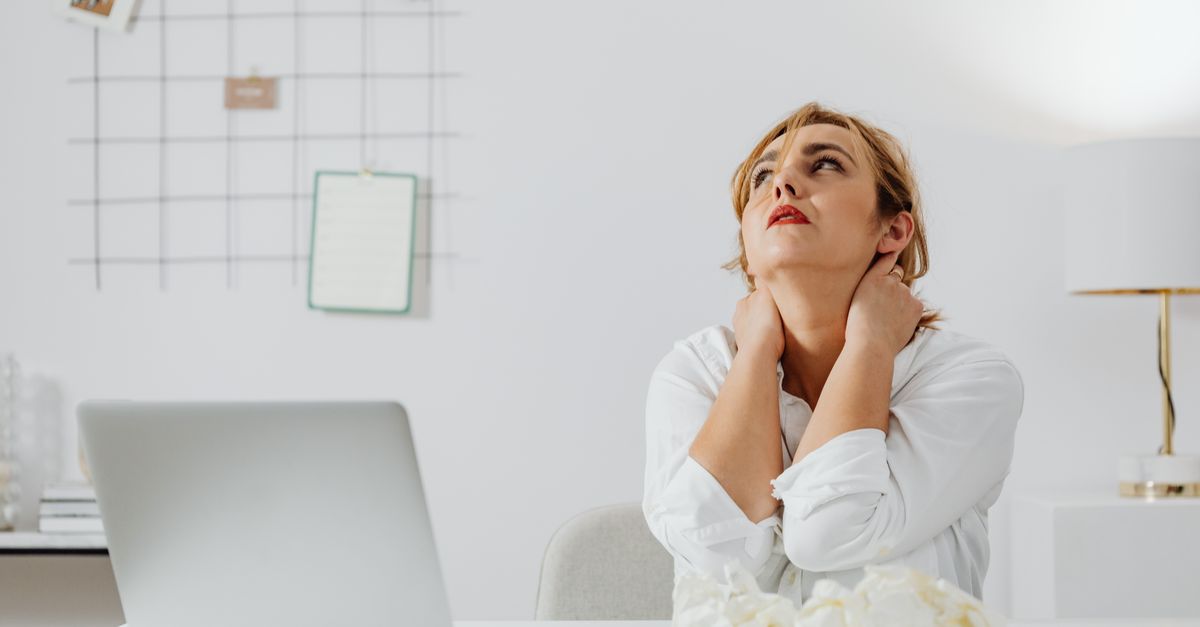
You hold stress mainly in the muscles of your neck and shoulders, jaw, lower back, and hands. Under stress, the nervous system triggers a protective bracing response that keeps these muscles partly contracted, and sustained contraction leaves them tight, sore, and short on blood flow. Noticing where tension collects, breathing slowly, moving regularly, and massaging tight areas can help release it. Persistent pain, numbness, chest symptoms, or anxiety that disrupts daily life are reasons to talk with a doctor.
The answer to "where do you hold stress in your body" is rarely abstract. Pay attention during a deadline, a tense phone call, or a long drive in traffic, and you can feel it: shoulders creeping toward your ears, molars pressed together, a fist wrapped around your phone, a dull ache settling into your lower back. These are physical symptoms of stress, and they follow predictable patterns in the muscles.
This guide is for you if you end the day with a stiff neck, a sore jaw, or a back that feels tighter than your workload should explain. Stress-related muscle tension is real, it shows up in how your muscles behave, and it responds to simple, repeatable habits. The sections that follow cover why muscles tighten under stress, the four areas that take the most load, how to catch tension early, how to release it, and when it is time to talk to a doctor.
Why Muscles Tighten Under Stress
Stress tension is not imagined, and it is not a sign of weakness. It is a physical reflex that made sense for short emergencies and causes problems when it never switches off.
The Stress Response Starts in the Nervous System
When your brain registers a threat, real or perceived, the sympathetic nervous system activates the fight-or-flight response. The adrenal glands release adrenaline and cortisol, your heart rate climbs, breathing quickens, and skeletal muscles tense in preparation to move or protect the body.
The American Psychological Association describes muscle tension as a near-reflex reaction to stress, a way of guarding the body against injury and pain. In a short burst, that bracing is useful. Once the threat passes, the muscles are supposed to let go.
Short-Term Bracing vs. Sustained Tension
Problems start when stress is ongoing. Work pressure, money worries, caregiving, and poor sleep can keep the alarm partially switched on, so your muscles never fully return to rest.
A muscle that stays partly contracted for hours compresses the small blood vessels running through it. Less blood flow means less oxygen arriving and slower removal of metabolic byproducts. That is one reason chronically tense muscles feel achy, knotted, and fatigued even when you have not used them hard.
What Makes Stress Tension Worse
Several everyday factors stack on top of the stress response:
- Shallow chest breathing, which recruits neck muscles like the scalenes and upper trapezius to lift the rib cage
- Long hours sitting with the head pushed forward over a screen
- Short or broken sleep, which leaves less time for muscles to recover
- Low daily movement, which removes the natural muscle pumping that keeps blood circulating
Mayo Clinic lists muscle tension or pain alongside headache and fatigue among the physical effects of stress, which helps explain why these symptoms tend to show up together.
Where Do You Hold Stress in Your Body?
Stress tension can appear almost anywhere, but four regions take the brunt of it. Knowing which one is yours makes it easier to catch tension before it settles in.
When you hear that the body "stores" stress, treat that as a figure of speech. Muscles do not hold emotions. The nervous system keeps sending signals that hold them in a contracted state.
Neck and Shoulders
Under pressure, you tend to lift your shoulders slightly and pull your head forward. That guarding posture loads several muscles at once:
- Upper trapezius, running from the top of the shoulders to the base of the skull
- Levator scapulae, connecting the side of the neck to the shoulder blade
- Suboccipitals, the small muscles just under the base of the skull
- Scalenes, along the front and side of the neck, which assist breathing
Tightness in the suboccipitals and upper trapezius can contribute to tension-type headaches that wrap around the forehead or sit at the back of the head. If this area is your main trouble spot, this deeper look at how stress contributes to neck pain covers it in detail.
Jaw
Jaw clenching from stress often happens without awareness, during concentration, while driving, or overnight. The masseter, the thick muscle at the angle of the jaw, and the temporalis, which fans across the temple, do the work. Daytime clenching and nighttime grinding are both forms of bruxism.
Mayo Clinic describes temporomandibular joint (TMJ) disorders as conditions that cause pain in the jaw joint and the muscles that control jaw movement. Ongoing clenching puts steady load on exactly those structures. Watch for a sore jaw on waking, headaches at the temples, clicking, or worn tooth edges.
Lower Back
Lower back pain from stress tends to build gradually. When you are tense, the erector spinae and quadratus lumborum brace the spine as if preparing to lift something heavy. Add long hours of sitting, which shortens the hip flexors and holds the lower back in one position, and the area ends the day stiff and achy.
Stress can also make you move less. Skipped walks and long stretches at a desk remove the movement that would otherwise loosen these muscles.
Hands and Forearms
The hands are an overlooked stress site. Tension shows up as a tight grip on a pen, mouse, steering wheel, or phone, as clenched fists, or as constant tapping. The forearm muscles that control grip run from the elbow to the fingers, so hours of unconscious gripping leave the forearms tight and the hands achy. Typing under deadline pressure compounds it.
How to Notice Tension Before It Builds
Stress tension is easiest to release before it settles in for the day. The challenge is that bracing becomes automatic, so you stop feeling it. A quick body check, done a few times a day, retrains that awareness.
Pause, take one slow breath, and scan for these cues:
- Shoulders raised toward your ears or rolled forward
- Teeth touching, or tongue pressed hard against your teeth
- Breath held or moving mostly in the upper chest
- Hands gripping, fists closed, or fingers curled
- Lower back rigid, or weight shifted onto one hip while sitting
- Brow furrowed or eyes squinting at a screen
Pair the check with something you already do, such as opening your email, sitting down for a meal, or stopping at a red light. A slower body scan before bed, moving attention from your feet up to your head and letting each area soften, builds the same skill.
Where Massage Fits for Stress-Related Muscle Tension
Massage does not change what is causing your stress. What it can do is work directly on the muscle side of the problem, mechanically moving tight tissue and increasing local blood flow in areas held contracted for hours. That makes it a useful complement to breathing, movement, and sleep habits. For a broader overview, see this guide to massage for stress relief.
Match the tool to the area:
- Back of the neck and top of the shoulders: a massager with kneading nodes and heat
- Upper, middle, and lower back: a broad, cushioned massage pad
- Jaw and hands: your own fingertips, covered in the routine below
For the Neck and Upper Shoulders
Kneading-type pressure combined with warmth suits the neck and upper shoulders. The Neck Massager with built-in heat uses dual-direction rotating massage nodes positioned on the back of the neck and across the upper shoulders. The nodes mimic hand kneading on the trapezius muscle, helping loosen tissue that tightens from poor posture or extended screen time.
If your stress tension tends to show up as tension headaches, placement at the base of the skull matters. Dual-direction massage nodes loosen the muscles at the base of the neck, helping ease tension that contributes to headache pain. For neck stiffness, rotating massage nodes combined with built-in heat warm and loosen tight muscles, supporting blood flow through the neck.
For the Back
Body massagers are often sold as vibration massagers. MedMassager uses oscillating technology to deliver deeper, more controlled vibration than conventional massagers. The Body Massager oscillates in a circular motion, and its large, soft, cushioned contouring pad forms to the curve of your back. You can hold it by its slip-resistant handles or rest it between your back and the back of a chair while seated.
For back pain tied to stress and long hours at a desk, the circular oscillating action reaches into the muscle, increasing local blood flow in tissue affected by prolonged sitting. Variable speed lets you start gently and adjust as the muscle loosens. You can compare the Classic and Plus models in the professional-grade body massager collection. Both are FDA-registered Class I medical devices.
Releasing Stress You Hold in Your Body
This routine works through each of the four stress zones. The breathing and stretching steps take a few minutes and need no equipment. Add the massage steps when you have time to sit for a longer session.
- Breathe low and slow. Sit tall with one hand on your belly. Inhale through your nose for about 4 seconds so your belly rises, then exhale for about 6 seconds. Continue for 2 to 3 minutes. Belly breathing gives the neck muscles a break from lifting the rib cage.
- Reset your neck and shoulders. Shrug your shoulders toward your ears, hold for 3 seconds, then let them drop fully. Repeat 5 times, then do 5 slow chin tucks, drawing your head straight back without tilting it.
- Unclench your jaw. Rest your lips together with your teeth slightly apart and your tongue resting on the roof of your mouth. Press two fingertips into the masseter and make slow circles for 30 to 60 seconds on each side.
- Open your hands. Spread your fingers wide for 5 seconds, then make a loose fist. Repeat 10 times. Follow with a gentle wrist stretch for 20 to 30 seconds per side.
- Massage your neck and upper shoulders. Position the Neck Massager on the back of your neck with the nodes resting across the base of the skull and the top of the shoulders. Start with about 10 minutes, once or twice a day. Stop if anything feels sharp, numb, or too hot.
- Work your back with the Body Massager. Start with about 10 minutes at the lowest setting, once or twice a day. Rest the pad between your back and your chair, or apply it directly while lying down, moving it from the upper back to the muscles alongside the spine and down to the lower back. The circular oscillating action moves the tight tissue and supports blood flow through the muscles while you use it. Raise the speed gradually only if it stays comfortable.
- Move every 30 to 60 minutes. Stand, walk for a minute or two, and stretch your hip flexors with a gentle lunge to take load off the lower back.
When to Talk to a Doctor About Stress
Stress-related muscle tension is usually manageable with self-care. However, some symptoms that feel like stress tension come from other causes, and stress or anxiety itself can reach a point where professional support matters.
Physical Symptoms That Need a Medical Check
Contact a doctor promptly, or seek emergency care where noted, if you notice any of the following:
- Chest pain, pressure, or shortness of breath (seek emergency care)
- Numbness, tingling, or weakness in the arms, hands, or legs
- Neck or back pain following a fall, accident, or injury
- A sudden, severe headache (seek emergency care), or headaches that are new or changing in pattern
- Pain that wakes you at night or comes with fever or unexplained weight loss
- Jaw pain that limits how far you can open your mouth
- Tension that has not improved after a few weeks of consistent self-care
If you have a heart condition, a pacemaker, a blood clotting disorder, or are pregnant, ask your own care team before using any massager.
When Stress or Anxiety Itself Warrants Support
Talk to your primary care doctor or a licensed mental health professional if stress or anxiety disrupts your sleep, work, relationships, or appetite for more than a couple of weeks. Constant worry, panic attacks, or feeling unable to switch off are worth raising directly, as is relying on alcohol or other substances to cope.
Massage and breathing exercises address muscle tension. They are not a treatment for anxiety disorders or depression. If you have thoughts of harming yourself, call or text 988 in the US to reach the Suicide & Crisis Lifeline right away.
Frequently Asked Questions
What part of the body holds the most stress?
The neck and shoulders, especially the upper trapezius, take a large share of stress tension because a guarding posture lifts the shoulders and pulls the head forward. The jaw, lower back, and hands are the other main areas. Where you feel it most depends on your posture, daily habits, and how you breathe under pressure.
Can stress cause neck and shoulder pain?
Yes. Stress keeps the upper trapezius, levator scapulae, and the muscles at the base of the skull partly contracted, which limits blood flow through them and leaves them sore and stiff. Long screen time and shallow breathing add to the load. If neck pain comes with numbness or weakness, or follows an injury, see a doctor.
Why do I clench my jaw when I'm stressed?
Jaw clenching is part of the body's bracing response, and it often happens unconsciously during concentration or sleep. Over time it tires the masseter and temporalis muscles and strains the jaw joint. Keeping your teeth apart with your lips closed during the day helps, and a dentist can check for signs of nighttime grinding.
Can stress cause lower back pain?
Stress can contribute to lower back pain by keeping the erector spinae and deep core muscles braced for long periods. Long hours of sitting add stiffness by holding the spine in one position and shortening the hip flexors. Back pain with leg numbness, weakness, fever, or loss of bladder or bowel control needs prompt medical attention.
How do you release stress stored in your muscles?
Start by noticing where you are bracing, then deliberately relax that area with slow belly breathing, shoulder drops, and gentle stretches. Regular movement breaks restore blood flow to muscles held still for long periods. Massage, whether with your hands or a therapeutic massager, mechanically loosens tight tissue and increases local circulation.
Does massage help with stress-related muscle tension?
Massage works on the muscle side of stress by moving tight tissue and increasing local blood flow in areas held contracted. It does not address the source of the stress, so it works best alongside sleep, movement, and support from your care team when needed. Short, regular sessions on the neck, shoulders, and back are a practical starting point.
When should I see a doctor about stress?
See a doctor if muscle tension persists after a few weeks of self-care, if pain comes with numbness, weakness, or chest symptoms, or if headaches are new or severe. Also talk to a doctor or mental health professional when stress or anxiety disrupts your sleep, work, or relationships. A medical evaluation rules out other causes and opens access to treatment options that self-care cannot provide.
The Bottom Line
Where you hold stress in your body comes down to how your nervous system braces, and the neck and shoulders, jaw, lower back, and hands take the most load. Catching that bracing early, breathing low, moving often, and working tight muscles with massage all help bring them back toward rest.
If tension collects at the base of your skull and across your shoulders, look at the Neck Massager for the back of the neck and shoulders. For your back, explore therapeutic body massagers with circular oscillating action, which moves tight tissue and supports blood flow in the muscles during use, or browse the full MedMassager catalog to compare options.
This content is for informational purposes only and is not intended as medical advice, diagnosis, or treatment. Always consult a qualified healthcare professional before starting any new treatment or therapy. MedMassager products are FDA-registered Class I medical devices.


