
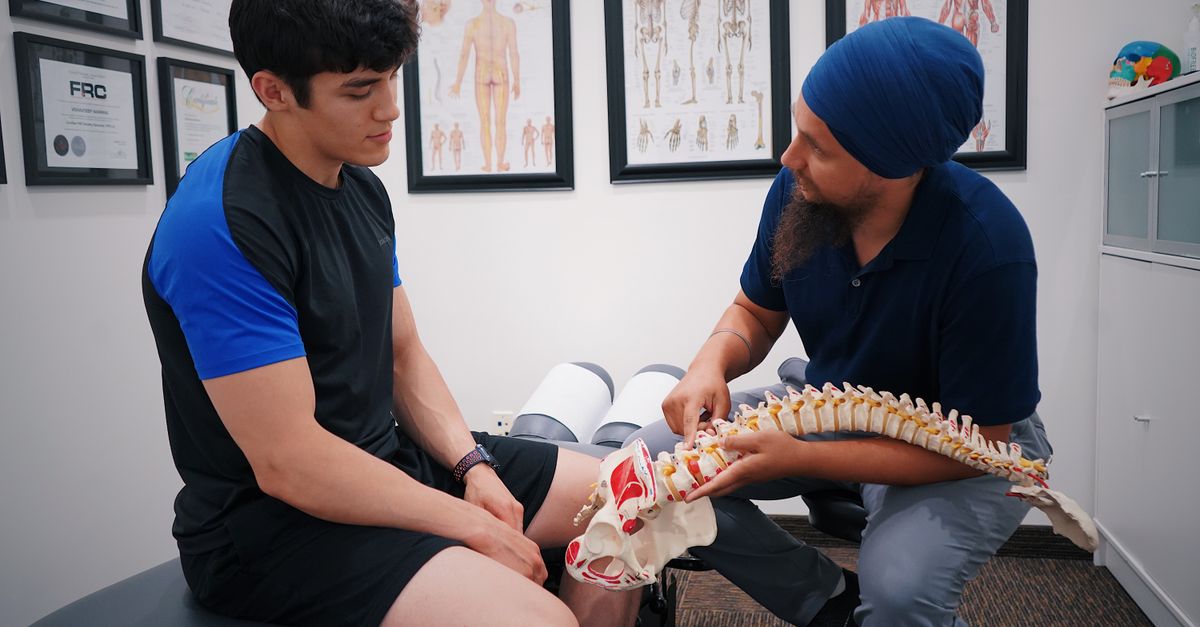
Massage with a herniated disc can be appropriate when it is gentle, avoids direct pressure on the spine, and has been approved by your doctor or physical therapist. Light massage of the surrounding muscles, such as the glutes and the muscles beside the spine, may ease tension from protective muscle guarding, but massage does not repair or reposition the disc. Massage should wait during a severe flare-up or whenever nerve symptoms are getting worse. Numbness in the groin or inner thighs, new bladder or bowel changes, or worsening leg weakness require emergency medical care.
If you have just been told you have a herniated disc, one of the first questions you may have is whether massage with a herniated disc is safe. Your lower back feels locked up, your glutes ache, and pain may shoot down one leg, so hands-on work sounds appealing. The honest answer depends on where the herniation is, how severe your symptoms are, and what your doctor or physical therapist has cleared you to do.
This guide is for anyone living with a lumbar disc herniation or sciatica who wants to understand where massage fits and where it does not. It is a safety guide, not a treatment plan, and your care team has the final word on every step. You will find what a herniation is, when gentle massage of surrounding muscles may fit in, which areas to avoid, how to approach a handheld massager cautiously, and the red flags that mean you need emergency care.
What Happens When a Disc Herniates
Mayo Clinic describes a herniated disk as a problem with one of the rubbery cushions that sit between the vertebrae, the bones that stack to form the spine. Understanding the structure involved makes it much easier to see why some kinds of massage are reasonable and others are not.
The Anatomy of a Spinal Disc
Each intervertebral disc has two parts. The center, called the nucleus pulposus, is soft and gel-like. It is surrounded by a tougher, layered outer ring called the annulus fibrosus.
A herniation happens when part of the soft center pushes through a tear or weak spot in the outer ring. Herniations occur most often in the lumbar spine, the lower back region that carries much of the body's weight during sitting, bending, and lifting.
Why a Herniation Causes Leg Pain
The disc itself is only part of the problem. When herniated material presses on or chemically irritates a nearby nerve root, symptoms can travel far beyond the back. When a lower lumbar nerve root is involved, the result is often sciatica: pain that follows the path of the sciatic nerve through the buttock and down the back of the leg.
Symptoms of a lumbar herniation can include:
- Pain in the lower back, buttock, thigh, or calf, often on one side
- Numbness or tingling in the leg or foot
- Weakness in the muscles served by the affected nerve
- Pain that worsens with sitting, bending forward, coughing, or sneezing
Disc herniations sometimes appear on imaging in people who have no pain at all. A scan alone does not tell the whole story, which is one reason your clinician's hands-on assessment matters.
Muscle Guarding: The Part Massage Can Address
When the spine is injured, the muscles around it tighten reflexively to limit movement and protect the area. This protective spasm, known as muscle guarding, commonly involves the paraspinal muscles along the spine, the quadratus lumborum in the low back, and the gluteal and piriformis muscles in the hip.
That secondary tightness can become its own source of pain and stiffness. It is this muscle tension, not the disc, that gentle massage is meant to address.
Is Massage With a Herniated Disc Safe?
Massage with a herniated disc can be safe when the timing is right, the pressure is light, and the work stays on the muscles surrounding the injury. It can also aggravate symptoms if it happens too early or targets the wrong spot. The deciding factors are your current symptoms and your clinician's guidance.
When Gentle Massage May Fit In
Gentle massage is more likely to be appropriate once the situation has stabilized. Signs that it may be time to ask your doctor or physical therapist about it include:
- Your diagnosis has been confirmed by a qualified clinician
- The most intense phase of the flare has passed
- Your leg symptoms are stable or improving, not spreading
- You have no numbness, weakness, or bladder or bowel changes that are getting worse
- Your clinician has specifically said light massage of surrounding muscles is acceptable
When to Wait
Hold off on massage during a severe acute flare, especially in the first days after symptoms begin. Also wait if numbness or weakness is increasing, or if pain is traveling farther down the leg than before. Symptoms that move farther from the spine generally suggest the nerve is more irritated, not less.
Massage should also wait after recent spinal surgery or a spinal injection unless your surgeon or physician clears it, and whenever back pain comes with fever, unexplained weight loss, or a history of cancer. For a broader look at situations where a massager should not be used, see our full guide to massager contraindications and safety.
Why Your Clinician Gets the Final Say
No two herniations behave the same way. A physical therapist may be guiding you through specific directional exercises, and massage should support that plan rather than work against it.
Ask your clinician direct questions: which muscles are safe to work on, how much pressure is acceptable, and which symptoms mean you should stop. Their answers should shape everything in the rest of this guide.
Where to Massage and What to Avoid
The core rule is simple. Work the muscles around the problem, never the problem itself. Direct pressure on an injured spinal segment adds load to tissue that is already irritated.
Areas That May Be Appropriate
With your clinician's approval, these areas are the usual focus for gentle massage around a lumbar herniation:
- The gluteal muscles across the buttocks
- The outer hips and the piriformis region
- The paraspinal muscles a few inches to either side of the spine, not on it
- The hamstrings and calves, if they have tightened along with your sciatica
Keep Pressure Off the Spine
Avoid pressing on the bony bumps that run down the center of your back, and stay away from the specific level where your herniation sits. Deep, forceful pressure, aggressive stretching, twisting, and spinal cracking all belong on the avoid list unless a licensed clinician is performing a technique they have chosen for your case.
The goal is muscle relaxation, not intensity. If a technique makes you brace, hold your breath, or tense up, it is too much for an injured back.
Positioning Matters
Choose a position that does not increase your leg symptoms. Lying on your side with a pillow between your knees takes strain off the low back for many herniation patterns. Lying face-down with a pillow under the hips works for some backs and aggravates others. Your physical therapist can tell you which positions suit your particular herniation.
How Oscillation Fits Around a Herniated Disc
If your clinician approves self-massage, a handheld therapeutic massager can let you work on the surrounding muscles at a pressure you control. The type of motion and the ability to keep intensity low both matter more than raw force.
Oscillation vs. Standard Vibration
Many body massagers are sold as vibration massagers, which typically rely on a motor shaking the unit. MedMassager uses oscillating technology to deliver deeper, more controlled vibration than conventional massagers. The MedMassager Body Massager oscillates in a circular motion, combining vibration with circular rotation through a large, soft, cushioned contouring pad that forms to the body.
That broad, cushioned pad spreads the motion across a wide area instead of driving it into a single point. For a sensitive back, broad and controlled is the right direction.
What It Can and Cannot Do
For the back muscles that tighten around a herniation, oscillation penetrates deep muscle layers, increasing local blood flow in muscles affected by prolonged sitting. For the glutes and hamstrings that often tighten with sciatica, deep oscillation increases local blood flow in large muscle groups, supporting recovery during rest. You can read more about this in our article on how massage fits into a sciatica plan.
Just as important is what a massager does not do:
- It works on muscle tissue, not on the disc itself.
- It does not reposition herniated material or take pressure off a nerve root.
- It does not replace the exercises, medication, or other care your clinician has prescribed.
Why Low Intensity Comes First
MedMassager's therapeutic body massagers are built for deep muscle work. With a herniated disc, that is a reason to start at the bottom of the intensity range, not the top. The Body Massager's variable speed lets you begin at the lowest setting and only increase if your clinician agrees and your symptoms stay calm.
The Body Massager is an FDA-registered Class I medical device. That registration describes its regulatory category, not permission to use it on your back, so the decision still belongs to you and your care team.
A Cautious Herniated Disc Massage Routine
Use this routine only after your doctor or physical therapist has approved self-massage of the surrounding muscles. The Body Massager with a cushioned contouring pad is held by its slip-resistant handles and applied directly to the target muscle. The circular oscillating action creates continuous, repetitive movement in the surrounding glute and back muscles, which supports circulation during use, while the pad stays away from the spine itself.
- Confirm the plan with your clinician. Ask which areas are acceptable, how long each session should be, and which symptoms mean you should stop.
- Get into a supported position. Sit upright in a stable chair or lie on your side with a pillow between your knees, whichever does not increase your leg symptoms.
- Set the lowest intensity. Start with about 5 minutes per area at the lowest setting, once a day.
- Begin with the glutes. Rest the pad on the gluteal muscle on the affected side, then the opposite side, keeping your body relaxed.
- Move to the muscles beside the spine only if cleared. Place the pad several inches to one side of the spine, never centered over it or over the herniated level.
- Check in during and after. Note how your back and leg feel during the session, later that day, and the next morning.
- Progress slowly. After several days without a flare, you may add a few minutes per area, staying within the limits your clinician set.
If you are comparing options in the main MedMassager catalog, the Body Massager is the handheld oscillating massager designed for the back, glutes, and legs.
Red Flags That Need Emergency Care
Some symptoms point to severe compression of the nerve roots at the base of the spinal canal, a condition called cauda equina syndrome. It needs urgent treatment to protect nerve function, so these signs are never something to massage through or wait out.
Call 911 or Go to the Emergency Department
Seek emergency care right away if you notice any of the following:
- Numbness in the groin, genitals, buttocks, or inner thighs
- New difficulty urinating, inability to urinate, or loss of bladder control
- New loss of bowel control
- Leg weakness that is getting worse, or a foot that drags or slaps when you walk
- Severe pain, numbness, or weakness in both legs
Stop Massage and Call Your Clinician
Other changes are not emergencies but still mean you should pause all massage and contact your doctor or physical therapist. These include pain that spreads farther down your leg, new tingling or numbness, or a sharp increase in back or leg pain after a session.
The same applies if your symptoms simply are not improving over time. Lack of progress is useful information for your care team, and it may mean your plan needs adjusting.
Frequently Asked Questions
Can massage make a herniated disc worse?
Yes, massage can aggravate a herniated disc if it involves deep pressure directly on the spine, aggressive twisting or manipulation, or takes place during a severe flare. Gentle work on surrounding muscles carries less risk, but it is not risk-free. If your leg symptoms spread, numbness increases, or pain spikes after a session, stop and contact your clinician.
Is it safe to use a massager with a herniated disc?
A massager should never be used directly on the spine over a herniated disc. With your clinician's approval, a handheld massager may be used at a low setting on surrounding muscles such as the glutes and the muscles to either side of the spine. On the MedMassager Body Massager, the cushioned pad oscillates in a circular motion, and oscillation penetrates deep muscle layers, increasing local blood flow in muscles affected by prolonged sitting. It works on muscle tissue only and does not change the disc itself.
Does massage help sciatica from a herniated disc?
Massage can address tension in the glutes, piriformis, and low back muscles that often tighten alongside sciatica. It does not take pressure off the irritated nerve root, which is the underlying source of the leg pain. Gentle massage is best treated as one supportive piece of a plan built by your doctor or physical therapist.
Should I use heat or ice on a herniated disc?
Ice is often suggested during the first few days of a flare, and heat is often used later to relax tight muscles. Your clinician can tell you which fits your stage of healing. Avoid applying heat or ice to areas with numbness, because reduced sensation makes it harder to notice skin damage.
How long does a herniated disc take to heal?
Symptoms from a herniated disc often improve over several weeks with conservative care such as activity changes, physical therapy, and medication your doctor recommends. Some cases take longer, and a small number require procedures or surgery. Your clinician can give you a realistic timeline based on your imaging, symptoms, and progress.
Can a massage therapist work on a herniated disc?
A licensed massage therapist can work around a herniated disc if they know your diagnosis and have guidance from your clinician. Tell them the level of your herniation, your current symptoms, and any restrictions your doctor or physical therapist has given. A qualified therapist will avoid direct pressure on the spine and stop if your symptoms change.
The Bottom Line on Herniated Disc Massage
Massage with a herniated disc is about working the tense muscles around the injury, never pressing on the spine itself. Gentle, low-intensity work on the glutes and the muscles beside the spine may fit into your plan once the acute phase settles and your doctor or physical therapist approves it.
Learn the emergency red flags, stop at the first sign of spreading symptoms, and let your care team set the limits. If your clinician clears self-massage, you can explore the MedMassager Body Massager collection to see how the cushioned, oscillating pad works on surrounding back and glute muscles at the low settings a sensitive back needs. The circular oscillating action creates continuous, repetitive movement in those muscles, which supports circulation during use without touching the disc itself.
This content is for informational purposes only and is not intended as medical advice, diagnosis, or treatment. Always consult a qualified healthcare professional before starting any new treatment or therapy. MedMassager products are FDA-registered Class I medical devices.


