
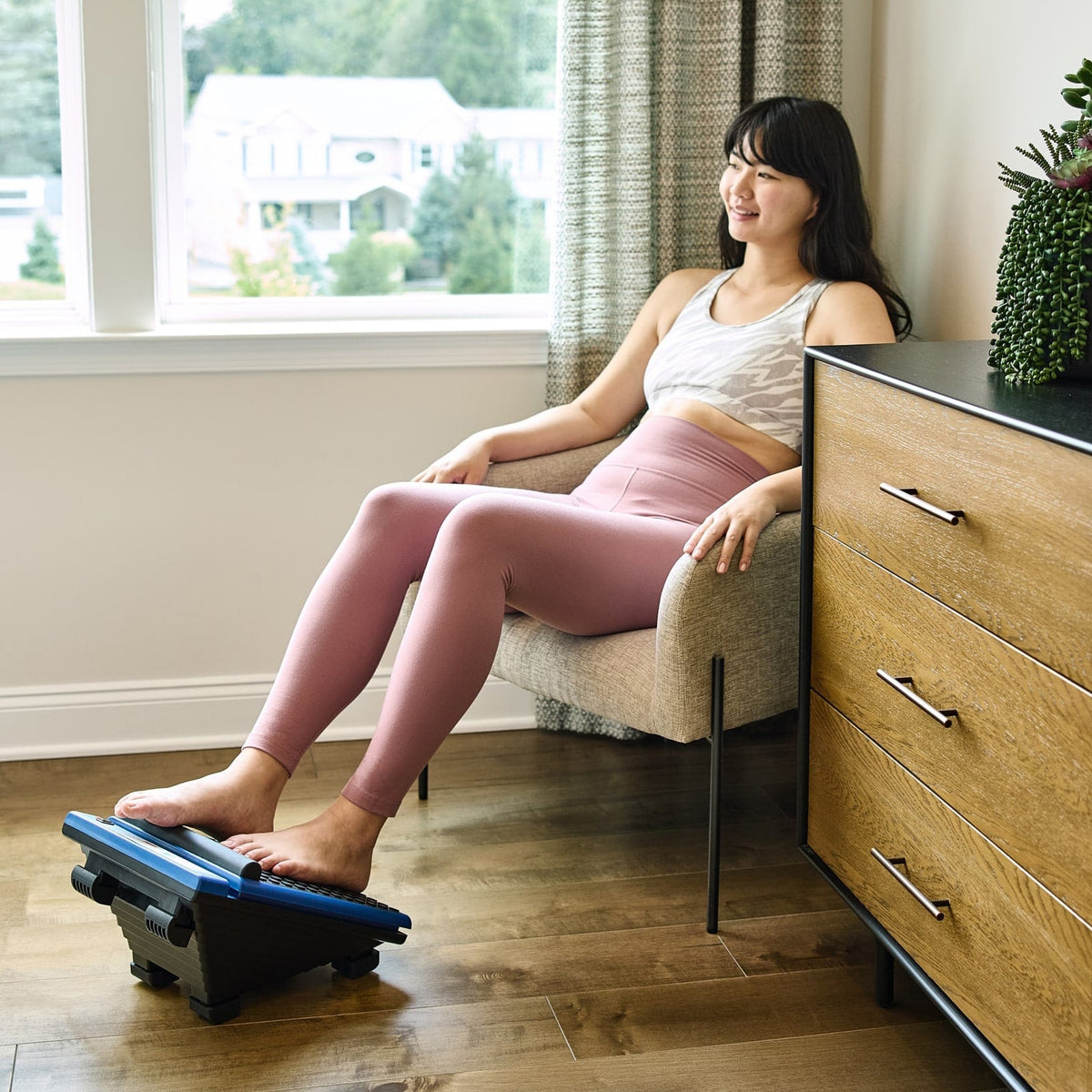
The best foot massager for arthritis has gentle, adjustable intensity, an open flat platform that does not squeeze swollen joints, and a design built for seated use. Enclosed shiatsu and air-compression units press on the toes, midfoot, and ankles, which many people with arthritic feet find uncomfortable. The MedMassager Foot Massager meets all three criteria: it oscillates in a circular motion across an open platform, with multiple intensity settings so you can start low. Its circular oscillating action engages the calf muscles and supports circulation in the feet and lower legs alongside your doctor's treatment plan, but it does not treat arthritis itself.
Anyone with arthritis in their feet knows the first few steps out of bed: the big toe won't bend, the ankle feels rusted in place, and walking to the kitchen takes more effort than it should. If you're shopping for the best foot massager for arthritis, you've probably noticed that most models aren't designed for joints that are stiff, swollen, or tender to the touch.
Many popular foot massagers are built around squeezing and kneading. That works for tired, healthy feet, but it can be a poor match for an inflamed big toe joint or an arthritic midfoot. This guide is for readers who already know they want a foot massager and need help choosing one that fits arthritic feet rather than fighting them.
Below, you'll find what arthritis does to the joints of the foot, which features matter most, how massager types compare, our recommendation, and a safe seated routine to follow.
What Arthritis Does to Your Feet
Arthritis is not one condition. It is a group of more than 100 joint disorders, and several of them commonly settle in the feet. Knowing which joints are involved helps explain why some massager designs work better than others.
Why the Feet Are So Vulnerable
Each foot contains 26 bones and more than 30 joints, all held together by ligaments, tendons, and cartilage. These joints carry your full body weight with every step, so wear and inflammation show up quickly as pain and stiffness. The joints most commonly affected include:
- The big toe joint (first metatarsophalangeal joint), which bends with every step you take
- The midfoot joints, which form the arch and absorb impact
- The ankle joint, where the shinbone meets the talus
- The subtalar joint just below the ankle, which lets the foot tilt on uneven ground
- The smaller toe joints, especially in inflammatory forms of arthritis
Osteoarthritis vs. Inflammatory Arthritis
Mayo Clinic describes osteoarthritis as the most common form of arthritis, occurring when the protective cartilage that cushions the ends of bones wears down over time. In the foot, it often appears in the big toe joint and midfoot, sometimes years after an old ankle sprain or fracture.
Rheumatoid arthritis works differently. It is an autoimmune disorder in which the immune system attacks the lining of the joints, and it frequently affects the small joints of the feet on both sides of the body. Gout and psoriatic arthritis are also inflammatory forms that can cause sudden swelling, redness, and heat in the toes and ankle.
How Stillness Makes Stiffness Worse
When your feet hurt, you naturally move them less. That makes sense in the moment, but long periods of stillness tend to leave arthritic joints feeling stiffer when you finally get up. Reduced movement also means the calf muscles do less of their normal work of pushing blood back up from the lower legs.
This cycle of pain, less movement, and more stiffness is the core problem a foot massager can address. A good one introduces movement without asking your joints to bear weight or absorb pressure.
How Oscillation Helps Arthritic Feet
Many foot massagers are sold as vibration massagers, and vibration is a reasonable place to start. Not all vibration is the same, though. MedMassager uses oscillating technology to deliver deeper, more controlled vibration than conventional massagers, moving the feet in a circular motion instead of simply buzzing against the skin.
Movement Without Pressure
The MedMassager Foot Massager oscillates in a circular motion while your feet rest on an open platform. Nothing clamps around the toes or presses into the ankle. The circular oscillating action moves the feet and engages the muscles of the lower leg, so the joints are moved rather than squeezed.
For arthritic feet, that distinction matters. Repeated muscle movement helps keep blood moving through the lower leg without stressing the joint. You get the benefit of motion during periods when walking or exercise is uncomfortable.
What a Foot Massager Can and Cannot Do
Setting realistic expectations is part of choosing well. Here is an honest breakdown of what therapeutic foot massagers are designed to do:
- Introduce passive movement to the feet and lower legs while you're seated
- Activate the calf muscles, supporting blood flow upward from the feet
- Help break up long stretches of stillness that tend to leave joints feeling stiff
- Offer a comfortable massage sensation at an intensity you control
A foot massager does not rebuild cartilage, reduce joint inflammation, or replace prescribed medication, physical therapy, or orthotics. It works best as one part of a plan you've built with your doctor.
What Makes the Best Foot Massager for Arthritis
When you compare foot massagers for arthritic joints, three features separate a good fit from a frustrating purchase. Price and appearance come well after these.
Gentle, Adjustable Intensity
Arthritis symptoms change from day to day. A setting that feels good on a calm morning can be too much during a stiff evening. Look for multiple intensity levels, including a genuinely gentle low setting, so you can match the massage to how your joints feel right now.
Avoid models with little room for adjustment, or ones that change intensity on their own. Control should stay with you.
An Open Platform, Not an Enclosed Chamber
Many foot massagers enclose the feet inside a chamber with rotating nodes or inflating air bags. That design works by applying pressure, which can be uncomfortable on swollen toes, bunions, or a tender ankle. An open flat platform lets your feet rest naturally without forcing them into a fixed shape, which helps if you have:
- Toes or ankles that swell during a flare
- Bunions, hammertoes, or other changes in foot shape
- Feet that are larger or smaller than an enclosed chamber expects
- Trouble bending down to guide your feet into a tight slot
Built for Seated Use
Some products marketed for the feet, such as vibration plates and exercise platforms, are designed to be stood on. Standing loads your arthritic joints with your full body weight, which defeats the purpose. A foot massager for arthritis should be used while sitting, with your feet resting on the platform and your weight supported by the chair. The circular oscillating action then moves the feet and engages the calf muscles, which supports circulation without loading the joint.
Comparing Massager Types for Arthritic Feet
The table below compares common categories of open-platform foot massagers and their alternatives:
| Massager Type | How It Works | Consideration for Arthritis |
|---|---|---|
| Oscillating platform | Feet rest on an open platform that moves in a circular motion | No squeezing; intensity can be adjusted to tolerance |
| Shiatsu (enclosed) | Rotating nodes inside an enclosed chamber knead the soles | Direct pressure may be uncomfortable on tender or swollen joints |
| Air compression | Air bags inflate around the feet and ankles | Squeezing can aggravate swelling or a painful flare |
| Vibration plate | A platform you stand on that vibrates | Standing places full body weight on arthritic joints |
| Basic vibrating footrest | A motor shakes the surface under the feet | Gentle, but generally less powerful and more surface-level |
Our Pick: Best Foot Massager for Arthritis
Based on the criteria above, the MedMassager Foot Massager is our recommendation for arthritic feet. It is an FDA-registered Class I medical device built around oscillation rather than squeezing.
Why It Fits Arthritic Feet
The Foot Massager checks each box that matters for arthritic joints:
- It oscillates in a circular motion, moving the feet without clamping or kneading them
- Its open flat platform accommodates swelling, bunions, and stiff toes
- Multiple intensity settings let you start gently and adjust as your joints allow
- It is designed for seated use, so your joints never bear weight during a session
Its oscillation delivers deeper, more controlled movement than a basic vibrating footrest. Because repeated foot motion activates the calf muscles, the circular oscillating action supports blood flow upward through the lower legs during long periods of sitting.
What It Won't Do
The Foot Massager does not treat, cure, or reverse arthritis. It won't regrow cartilage or calm an autoimmune response. What it offers is controlled, low-effort movement that supports circulation, used alongside whatever your doctor or physical therapist has recommended.
If Other Areas Hurt Too
Arthritis rarely stays in one place. If your hands, hips, or back are also involved, you can browse MedMassager's full lineup of therapeutic massagers to see which options fit other areas of the body.
How to Use a Foot Massager Safely
A careful routine gets more out of any adjustable-intensity foot massager while protecting sensitive joints. With arthritis, the goal is consistency at a comfortable level, not maximum strength.
- Talk to your doctor first. Confirm that a foot massager is appropriate for your type of arthritis and any other conditions you manage.
- Sit in a supportive chair. Keep your back supported and your knees comfortably bent, with the device on the floor in front of you.
- Rest your feet flat on the platform. Position your feet where they feel stable and relaxed.
- Start on the lowest setting. Begin with 5 to 10 minutes at low intensity for the first several sessions.
- Increase gradually. If your feet feel fine afterward, extend sessions to 15 to 20 minutes or raise the intensity one step at a time.
- Choose consistent times. Many people prefer mornings, when joints feel stiffest, or evenings after a long stretch of sitting.
- Stop if pain increases. Tingling that lingers after a session is a reason to stop and check with your doctor. Sharp pain, throbbing, or increased swelling is a signal to stop and check with your doctor.
Because the Foot Massager oscillates in a circular motion, your arthritic joints are moved without bearing weight. Repeated muscle movement helps keep blood moving through the lower leg without stressing the joint, which is why steady, moderate sessions usually work better than occasional intense ones.
Special Considerations Before You Buy
Some people with arthritis need to take extra care, and a few should skip foot massage entirely until they've spoken with a doctor.
Rheumatoid Arthritis, Gout, and Flares
Inflammatory arthritis tends to come in flares, when joints become hot, red, and visibly swollen. During an active flare, especially a gout attack, avoid massaging the affected foot and follow your doctor's guidance. Between flares, ask your doctor whether gentle, low-intensity sessions are appropriate for you.
Arthritis With Diabetes or Neuropathy
Arthritis often overlaps with diabetes, and diabetic nerve damage can reduce your ability to feel pressure or heat in the feet. If you live with both, ask your doctor or podiatrist before using any foot massager, check your feet daily for cuts or blisters, and keep intensity low. On the Foot Massager, the circular oscillating action moves the feet and activates the calf muscles, pushing blood upward instead of letting it pool in the feet.
When to Talk to Your Doctor First
Get medical clearance before using any foot massager if any of the following apply:
- A history of deep vein thrombosis or blood clots in the legs
- Recent foot or ankle surgery, including joint replacement or fusion
- Open wounds, ulcers, or skin infections on the feet
- Unexplained swelling in one leg, or calf pain with warmth and redness
- A pacemaker or other implanted electronic device
Frequently Asked Questions
What type of foot massager is best for arthritis?
An oscillating foot massager with an open platform and adjustable intensity is usually the best fit for arthritic feet. Open designs move the feet without squeezing tender joints, unlike enclosed shiatsu or air-compression models. Look for a model built for seated use so your joints never bear weight during a session.
Is shiatsu massage good for arthritic feet?
Shiatsu foot massagers rely on rotating nodes that press into the soles, and that pressure can be uncomfortable on swollen or tender joints. Some people with mild osteoarthritis tolerate shiatsu well, while others with inflammatory arthritis find it aggravating. If your joints are sensitive to touch, a design that moves the feet without kneading them is often more comfortable.
Can you use a foot massager during an arthritis flare?
Avoid massaging joints that are actively hot, red, and swollen, including during a gout attack. Massage during a flare can increase discomfort in already inflamed tissue. Wait until the flare settles, then resume at the lowest setting after checking with your doctor.
How long should you use a foot massager for arthritis?
Start with 5 to 10 minutes at low intensity for your first several sessions. If your feet feel fine afterward, you can work up to 15 to 20 minutes once or twice a day. Consistent moderate sessions are generally more comfortable for arthritic joints than long, intense ones.
Does a foot massager help with arthritis pain?
A foot massager does not treat arthritis, but it can help with stiffness by introducing movement when walking is uncomfortable. The MedMassager Foot Massager oscillates in a circular motion that activates the calf muscles and supports blood flow through the feet and lower legs. It is meant to be used alongside medication, physical therapy, and supportive footwear as part of a broader plan with your doctor.
What exercises help arthritis in the feet?
Gentle range-of-motion exercises such as ankle circles, toe curls, and pointing and flexing the foot help keep arthritic joints moving. Picking up a small towel with your toes strengthens the small muscles of the foot. A physical therapist can tailor a program to the specific joints and type of arthritis involved.
The Bottom Line
The best foot massager for arthritis moves your feet without squeezing them, lets you control the intensity, and keeps you seated so your joints never carry your weight. Enclosed compression and shiatsu designs can work for healthy feet, but they often press on exactly the joints that hurt.
The MedMassager Foot Massager is an FDA-registered Class I medical device that oscillates in a circular motion across an open platform, engaging the calf muscles and supporting circulation while you sit. Use it consistently, start low, and pair it with the care plan your doctor recommends. When you're ready, explore the MedMassager Foot Massager collection to find the right fit for your feet.
This content is for informational purposes only and is not intended as medical advice, diagnosis, or treatment. Always consult a qualified healthcare professional before starting any new treatment or therapy. MedMassager products are FDA-registered Class I medical devices.


